

Hardwood in kitchens: durability and design for Bay Area homes
TL;DR:
- Properly selected hardwood offers durability, warmth, and high resale value in Bay Area kitchens.
- Engineered hardwood is more stable than solid wood for local humidity and temperature fluctuations.
- Regular maintenance and correct installation practices extend hardwood floor lifespan in busy kitchens.
Hardwood floors in kitchens? Most homeowners assume it’s a risky choice, expecting warped planks and water-stained surfaces after the first spill. The truth is more interesting. When you choose the right species, the right format, and install it correctly for Bay Area conditions, hardwood actually competes with tile and vinyl on durability while running circles around them on warmth and resale value. Bay Area kitchens face a specific challenge: coastal humidity swings, diverse subfloor materials, and high foot traffic from daily cooking. This guide covers which hardwood options genuinely hold up, how to handle moisture, and what it all costs so you can renovate with confidence.
Table of Contents
- Hardwood in kitchens: benefits beyond beauty
- Choosing the right hardwood: solid vs. engineered for Bay Area conditions
- How to make hardwood last in busy kitchens
- Hardwood costs and value: budgeting for kitchen upgrades
- Why most guides undersell the real-world demands of Bay Area kitchen floors
- Ready to upgrade? Explore Bay Area hardwood options
- Frequently asked questions
Key Takeaways
| Point | Details |
|---|---|
| Engineered wood excels | Engineered hardwood provides the best stability and longevity in Bay Area kitchens. |
| Right species matter | Choose durable species like White Oak or Hickory for scratch resistance and daily wear. |
| Prep prevents issues | Proper acclimation, subfloor moisture testing, and moisture barriers extend the life of hardwood. |
| Routine care pays off | Prompt cleaning and using mats or rugs can prevent costly kitchen floor damage. |
| Budget for value | Hardwood delivers long-term value when you invest in quality installation and maintenance. |
Hardwood in kitchens: benefits beyond beauty
Tile is cold underfoot. Vinyl looks cheap after a few years. Hardwood, on the other hand, gets better with age when treated right. That’s the practical argument most flooring guides skip over in favor of surface-level style advice.
The first thing to understand is wood hardness. The Janka rating measures how much force it takes to embed a steel ball into a wood plank, which is a direct proxy for scratch and dent resistance. Durable species like Hickory (Janka 1820), White Oak (1360), Maple (1450) resist scratches and dents in high-traffic kitchens far better than softer species like Pine or Cherry. If you have kids, pets, or just a busy cooking life, these numbers matter.
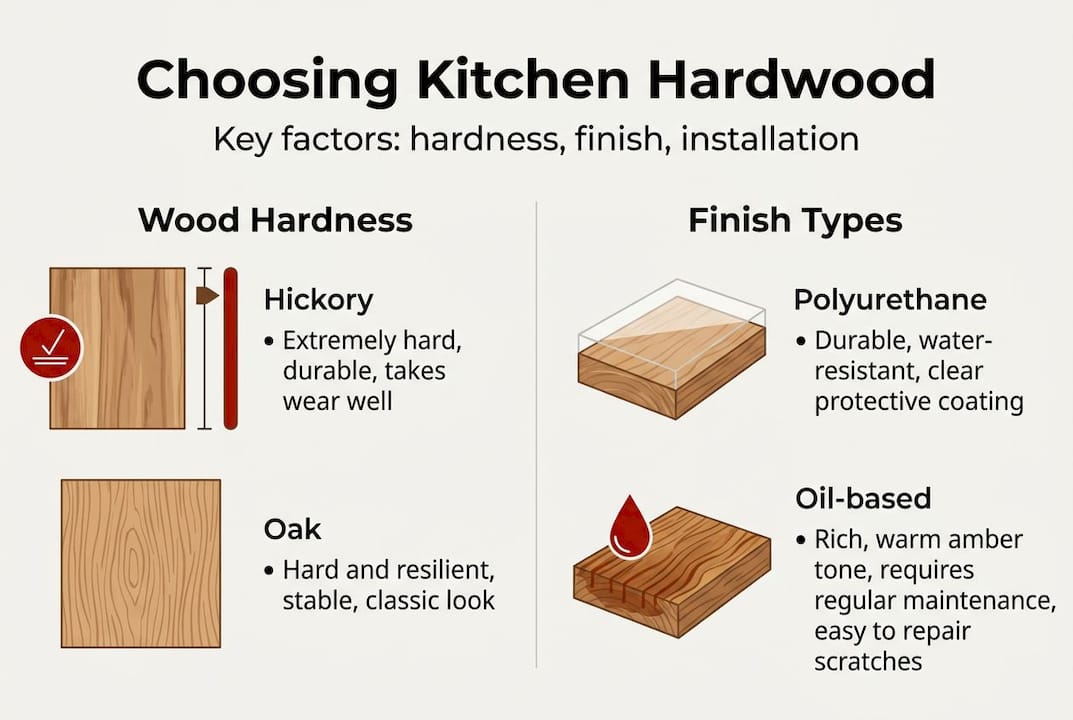
Beyond hardness, hardwood offers something tile and vinyl simply cannot: visual warmth. A kitchen with wide-plank White Oak floors reads as elegant whether the cabinets are white shaker, dark walnut, or industrial steel. That flexibility is rare in flooring materials. You can also explore most scratch-resistant wood types to narrow down the best species for your specific kitchen layout and traffic patterns.
Here’s a quick summary of why homeowners consistently choose hardwood for kitchen renovations:
- Natural warmth: Wood is softer underfoot than tile, reducing leg fatigue during long cooking sessions
- Design flexibility: Pairs with virtually any cabinet color, countertop material, or backsplash style
- Refinishing potential: Unlike tile or vinyl, hardwood can be sanded and refinished multiple times, essentially resetting its appearance
- Resale value: Buyers in the Bay Area housing market respond well to hardwood, often viewing it as a premium upgrade
- Longevity: Properly maintained hardwood in a kitchen can outlast two or three rounds of vinyl replacement
“The real cost of cheap flooring isn’t the price tag. It’s the replacement cycle. Hardwood done right is the last floor you buy for that room.”
That refinishing advantage deserves extra emphasis. If your tile chips or your vinyl peels, you replace it. If your hardwood gets scratched or dull, a professional sanding and refinishing job restores it to like-new condition. Over a 20- or 30-year horizon, that changes the math significantly.
Choosing the right hardwood: solid vs. engineered for Bay Area conditions
With hardwood’s appeal established, the next step is choosing the right type for local Bay Area demands. This is where a lot of homeowners get tripped up by national advice that doesn’t account for our specific climate.
The Bay Area is not a single climate. Fog-heavy areas like Daly City or the Sunset District see persistent moisture, while inland East Bay neighborhoods can swing from damp winters to dry, hot summers. That variability is hard on flooring. Solid hardwood, which is a single piece of wood milled to thickness, expands and contracts with humidity changes. In a stable Midwest climate, that’s manageable. Here, it can mean gapping in summer and buckling in winter.
Engineered hardwood solves this. Its cross-layered plywood core resists movement far better than solid wood. Engineered hardwood is more stable in Bay Area’s humidity swings of 50 to 85%, lasting 25 to 50 years versus solid’s 40 to 60 years in coastal areas, but requires proper acclimation and moisture barriers to reach those numbers. The tradeoff is that engineered boards can typically be refinished fewer times than solid planks.
Here’s a direct comparison to help you decide:
| Feature | Solid hardwood | Engineered hardwood |
|---|---|---|
| Humidity stability | Lower | Higher |
| Lifespan (Bay Area) | 40-60 years | 25-50 years |
| Refinishing potential | 5-7 times | 2-4 times |
| Subfloor compatibility | Wood only | Wood or concrete |
| Cost per sq. ft. (materials) | $6-$15 | $4-$12 |
| Best for kitchens? | Moderate | Yes |
The choice between engineered vs solid hardwood often comes down to your specific kitchen subfloor. Concrete slab? Engineered is your only real option. Wood subfloor with good vapor control? Solid is possible, but engineered still performs more predictably.
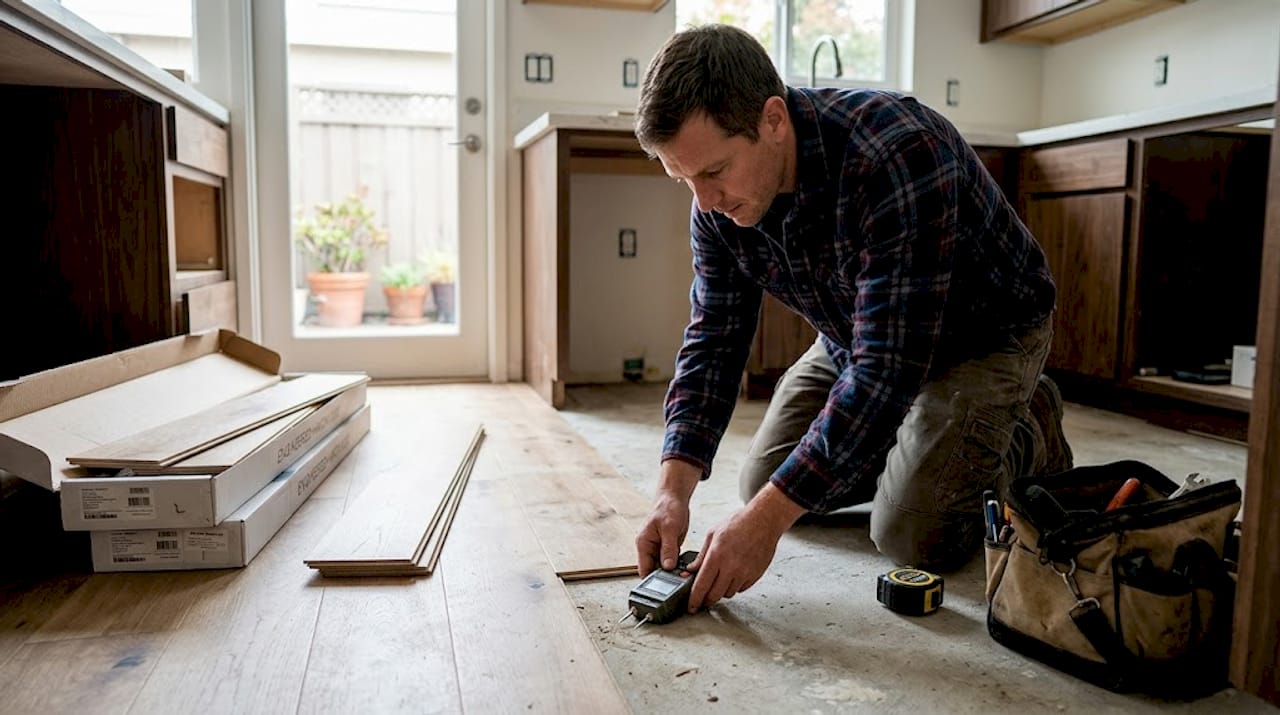
Proper flooring acclimation before install is non-negotiable in the Bay Area. Planks need to sit in your home’s environment, ideally 7 full days, before installation so they adjust to your indoor humidity level.
Pro Tip: Before any installation, rent a pin-type moisture meter and test your subfloor at multiple points. Readings above 12% signal a moisture problem that needs addressing before the first plank goes down. Skipping this step is the single most common cause of hardwood failure in kitchens.
How to make hardwood last in busy kitchens
After choosing your hardwood, let’s talk strategy: how can you keep that new kitchen floor looking its best, year after year? Durability is not just about the wood species. It’s about how you use and care for the floor daily.
For homes with kids, pets, or frequent entertaining, use rugs, prompt cleanup, and avoid installing solid wood directly on concrete slabs without professional guidance. These aren’t optional extras. They’re the difference between a 30-year floor and a 10-year floor.
Here’s a practical maintenance routine that actually works:
- Sweep or dry-mop daily: Kitchen floors collect food particles, dust, and grit constantly. Abrasive particles underfoot act like sandpaper on your finish over time
- Wipe spills within 2 minutes: Water sitting on hardwood longer than a few minutes can penetrate the finish and start to affect the wood beneath. Time matters more than product
- Use entrance and sink mats: Place waterproof-backed mats at the sink, dishwasher, and any door entries to catch moisture before it reaches the floor
- Felt pads on all chair and stool legs: A kitchen island with barstools without felt pads will show scratches within months. Check and replace pads every 6 months
- Avoid steam mops: Steam drives moisture directly into the wood and can void your warranty. Stick to slightly damp microfiber mops with a pH-neutral hardwood cleaner
- Schedule professional cleaning annually: A deep clean and light buffing once a year keeps the finish intact longer and pushes back the refinishing timeline
For deeper guidance on keeping wood looking sharp long-term, water-resistant maintenance tips walk through finish types and protective products worth considering. Families with young children will also find specific strategies in child-safe care tips that cover non-toxic cleaners and impact-resistant finish options.
Pro Tip: Apply a fresh coat of polyurethane finish every 3 to 5 years in kitchens. It’s far cheaper than refinishing and dramatically extends the life of your floor between full sand-and-coat jobs.
Hardwood costs and value: budgeting for kitchen upgrades
Protecting your kitchen hardwood is a worthwhile investment. Now, here’s what you should expect in terms of cost and long-term value.
Hardwood is not the cheapest option upfront. But it is frequently the best value over a 20-year window. Here’s what typical Bay Area kitchen hardwood projects look like in terms of cost:
| Cost category | Budget range | Notes |
|---|---|---|
| Materials (engineered) | $4-$12 per sq. ft. | Species, width, finish affect price |
| Materials (solid) | $6-$15 per sq. ft. | Premium species cost more |
| Professional installation | $4-$8 per sq. ft. | Higher in Bay Area labor market |
| Moisture barrier | $0.50-$1.50 per sq. ft. | Non-negotiable in Bay Area kitchens |
| Acclimation and prep | $200-$600 | Subfloor leveling if needed |
| Refinishing (future) | $3-$5 per sq. ft. | Every 7-10 years in kitchens |
For Bay Area kitchen renovations, prioritize engineered White Oak or Hickory with a Janka rating above 1,300 for the best durability and moisture balance across most budgets. These species hit the sweet spot of hardness, stability, and availability.
Here’s how hardwood stacks up against alternatives over 20 years in a 200-square-foot kitchen:
- Hardwood: Higher upfront cost, 1 to 2 refinishing cycles, no replacement needed. Total estimated spend: $4,500 to $7,000
- Tile: Moderate upfront cost, grout maintenance, possible re-grouting. Total estimated spend: $3,500 to $5,500
- Luxury vinyl plank (LVP): Lowest upfront cost, but likely 1 full replacement in 20 years. Total estimated spend: $3,000 to $5,000
The gap narrows significantly when you factor in resale. Bay Area buyers recognize hardwood and respond with stronger offers. For guidance on how long your investment holds up locally, hardwood longevity in Bay Area breaks down the numbers by neighborhood and floor type.
Why most guides undersell the real-world demands of Bay Area kitchen floors
Most national hardwood flooring guides are written for a generic American homeowner in a generic American climate. They talk about humidity in the abstract without acknowledging that a home in the Sunset District experiences dramatically different conditions than one in Walnut Creek or San Jose. That gap in context creates problems.
We’ve seen it repeatedly: homeowners follow generic installation advice, skip the full 7-day acclimation period because contractors are ready to go, and end up with floors that gap or buckle within two years. Engineered outperforms solid in Bay Area microclimates, and refinishing cycles are a key variable in hitting long-term longevity benchmarks that national guides simply average away.
Subfloor preparation is the other underrated factor. Concrete slabs in Bay Area homes, especially in older properties, often have latent moisture issues that a simple visual inspection misses. Concrete subfloor prep requires vapor testing and sometimes full epoxy sealing before any flooring goes down. And when acclimation prevents issues, it’s because the wood reached equilibrium with your home’s actual environment, not a climate-controlled warehouse. These details don’t make it into listicles. But they’re what separates a floor that lasts from one that fails.
Ready to upgrade? Explore Bay Area hardwood options
With reality-checked guidance in mind, it’s time to put your renovation plans into action.
At Kapriz Hardwood Floors, we carry a curated range of Bay Area hardwood flooring options that are specifically suited to local kitchens, from moisture-stable engineered White Oak to hard-wearing Hickory in every finish style. We don’t sell anything we wouldn’t install in our own homes.
If you’re unsure where to start, our team can help you match the right species, format, and finish to your kitchen layout, traffic level, and budget. We also carry durable kitchen flooring options for homeowners planning whole-home consistency, and if you’re thinking bigger, explore wood flooring for whole house for a unified look that flows from kitchen to living room seamlessly.
Frequently asked questions
Will kitchen spills ruin hardwood floors?
No. Hickory, White Oak, and Maple resist scratches and dents and hold up well against spills as long as you wipe up moisture promptly rather than letting it sit.
Is engineered hardwood better for Bay Area kitchens?
Yes. Engineered hardwood is more stable in Bay Area humidity swings and lasts 25 to 50 years with proper installation, making it the practical choice for most local kitchens.
What is the Janka rating and why does it matter?
The Janka rating measures a wood’s resistance to denting under pressure. Hickory (1820), White Oak (1360), Maple (1450) score high, which means they hold up better in kitchens where dropped pots and dragged stools are everyday realities.
What should I do before installing hardwood in my kitchen?
Acclimate your flooring for at least 7 days, test subfloor moisture with a meter, and install a vapor barrier. Subfloor moisture testing and acclimation are the two steps most likely to determine whether your floor thrives or fails within the first few years.
Recommended
- How to choose durable hardwood flooring for the Bay Area | Kapriz Hardwood Flooring Store
- Most durable flooring types for Bay Area homes | Kapriz Hardwood Flooring Store
- Hardwood floor design ideas for Bay Area homes | Kapriz Hardwood Flooring Store
- Which Durable Hardwood Flooring Is Perfect For Your Bay Area Home? | Kapriz Hardwood Flooring Store


