


Why acclimating hardwood flooring prevents costly issues
TL;DR:
- Proper hardwood acclimation prevents gapping, cupping, and buckling issues.
- Acclimation involves stabilizing wood to room moisture and temperature over several days.
- Skipping acclimation can void warranties and lead to costly repairs later.
Skipping hardwood acclimation is one of the most expensive mistakes a homeowner can make. Floors that look perfect on installation day can gap, buckle, or cup within weeks if the wood was never given time to adjust to your home’s environment. Skipping acclimation can result in gapping, cupping, or buckling after installation, turning a dream floor into a costly repair job. This guide breaks down what acclimation actually is, why it matters more than most people realize, and exactly how to do it right so your hardwood floor stays beautiful for decades.
Table of Contents
- The science behind hardwood acclimation
- What happens when you skip acclimation?
- How acclimation works: Key process and benchmarks
- Expert tips & edge cases: Real-world acclimation challenges
- The uncomfortable truth: Why so many skip acclimation and regret it
- Trust your hardwood flooring to experts
- Frequently asked questions
Key Takeaways
| Point | Details |
|---|---|
| Acclimation prevents flooring damage | Proper acclimation protects against gapping, cupping, and buckling after installation. |
| Moisture verification is crucial | Always use a moisture meter to confirm your hardwood is ready for installation. |
| Engineered floors need acclimation too | Even the most stable engineered hardwood requires acclimation to avoid problems. |
| Environmental conditions matter | Stabilizing your home’s temperature and humidity before acclimation ensures lasting results. |
The science behind hardwood acclimation
Wood is a living material, even after it’s been milled and finished. It constantly reacts to the moisture in the air around it. When humidity rises, wood fibers absorb moisture and the boards swell. When humidity drops, those same fibers release moisture and the boards shrink. This is why wood is hygroscopic, absorbing moisture in humid conditions and releasing it in dry ones, causing expansion and contraction throughout its life.
Not all movement is equal. Wood expands far more across its width (tangential direction) than along its length. This is why boards gap or cup rather than simply stretch end to end. The numbers are telling: Red Oak tangential expansion is 0.00369 in/in/%MC, meaning a 6-inch board moves roughly 0.022 inches for every 1% change in moisture content. Quartersawn boards move about 50% less, making them a more stable choice in environments with big humidity swings.
Here’s a quick comparison of how different cuts behave:
| Cut type | Movement rate | Stability | Best for |
|---|---|---|---|
| Flatsawn | High | Lower | Dry, stable climates |
| Quartersawn | Low (about 50% less) | Higher | Humid or variable climates |
| Riftsawn | Medium | Medium | Balanced environments |
Acclimation is the process of letting your hardwood reach what’s called its equilibrium moisture content (EMC), the point where the wood’s moisture level matches the room it will live in. Once the wood hits EMC, it stops moving. Install it before that point, and the floor will keep moving after it’s nailed down.
“The goal isn’t just to wait a few days. It’s to let the wood stabilize to the exact conditions of the room where it will be installed, so it has nowhere left to go.”
The importance of acclimation cannot be overstated, especially in regions with seasonal humidity changes. A floor installed in summer humidity without acclimation may shrink dramatically come winter, leaving unsightly gaps between every board.
Key facts about wood movement:
- Tangential (width) movement is always greater than radial (thickness) movement
- Flatsawn boards show the most movement, quartersawn the least
- Even small MC changes of 1-2% can cause visible gapping or cupping
- Species matter: denser woods like Hickory move differently than softer species like Pine
What happens when you skip acclimation?
While science explains movement, the effects are all too real for homeowners when acclimation is ignored. The three most common problems are gapping, cupping, and buckling, and each one is both ugly and expensive to fix.
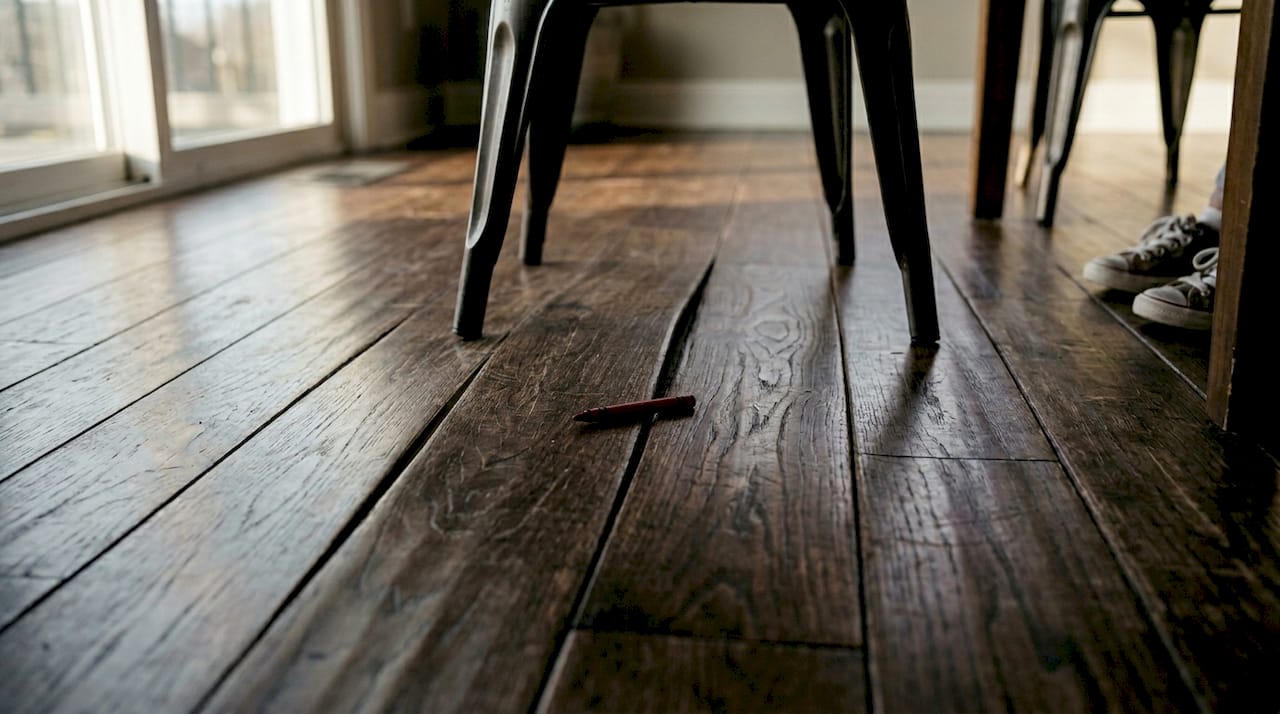
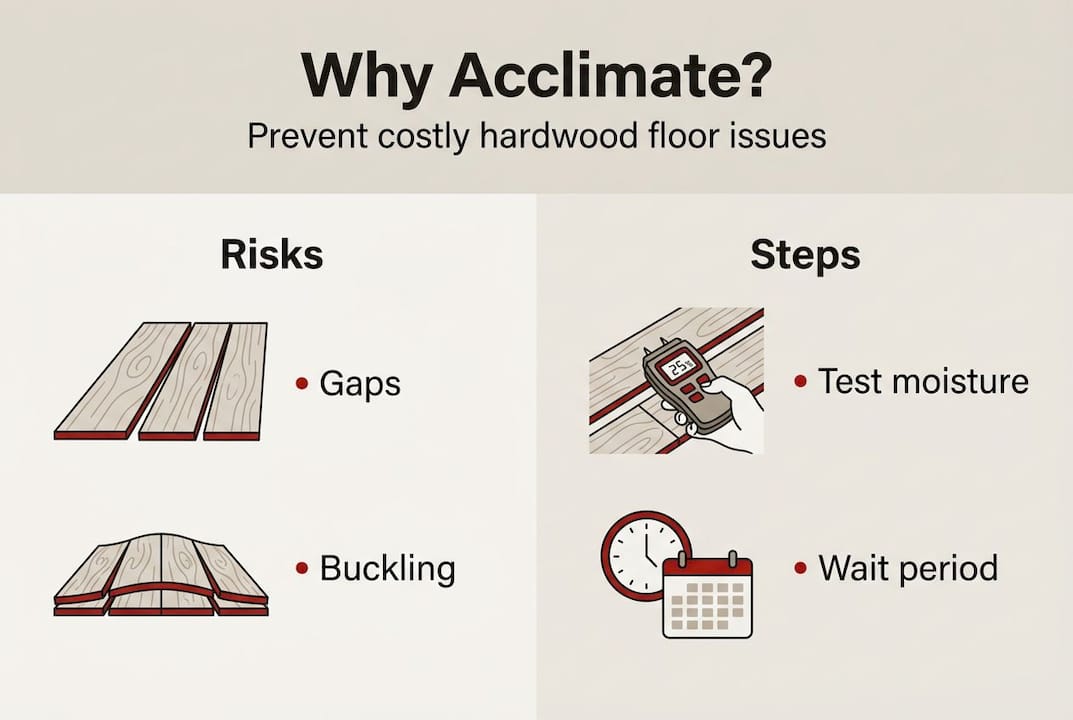
Gapping happens when dry air pulls moisture out of boards that were installed too wet. Boards shrink and pull apart, leaving visible cracks between them. Cupping occurs when the bottom of a board holds more moisture than the top, causing the edges to rise and the center to dip. Buckling is the most dramatic failure: boards that were installed too dry absorb moisture, expand, and literally lift off the subfloor.
These common flooring issues are almost entirely preventable with proper acclimation. The risks include:
- Gapping: Shrinkage in dry air pulls boards apart
- Cupping/crowning: Uneven expansion warps board surfaces
- Buckling: Excess expansion forces boards off the subfloor
- Warranty voidance: Most manufacturers will not cover failures caused by skipping acclimation
That last point stings the most. You could spend thousands on premium hardwood, skip this one step, and find yourself with zero warranty protection when things go wrong.
Pro Tip: Even engineered hardwood, which is more dimensionally stable than solid wood, still requires acclimation. The veneer layer on top is real wood and it still moves. Don’t assume “engineered” means “skip the wait.”
Proper floor installation prep always includes acclimation as a non-negotiable step. Contractors who rush this step to save a day or two are setting you up for problems months down the road. Always ask your installer what their acclimation protocol is before work begins.
One more thing worth knowing: moisture problems are not always obvious. A subfloor that looks dry can still have elevated moisture levels that will transfer to your new boards. Measuring multiple spots across the subfloor before and during acclimation is the only way to catch hidden issues before they become expensive ones.
How acclimation works: Key process and benchmarks
Recognizing these risks makes it clear why acclimation protocols are necessary before installation. The good news is that the process itself is straightforward, as long as you follow it correctly.
Acclimation is not just about leaving boxes in a room and waiting. The environment has to be right first. Acclimation allows hardwood to reach EMC with the installation environment’s temperature (60-80°F) and relative humidity (30-50% or 35-55%), preventing post-installation movement. Your HVAC system must be running and the room must be at normal living conditions before the wood goes in.
Here’s how to do it step by step:
- Stabilize the room first. Run heating or cooling for at least 48 hours before bringing in the wood.
- Open the boxes. Sealed boxes trap moisture. Open them and stack boards with spacers to allow airflow on all sides.
- Place boards in the installation room. Not the garage, not a hallway. The actual room where they’ll be installed.
- Check moisture with a meter. Don’t guess. NWFA guidelines specify RH of 30-50% and a moisture content difference between floor and subfloor of no more than 2-4%.
- Wait until the numbers match. Acclimation is condition-based, not time-based. Solid hardwood typically takes 3-14 days (usually 5-7), engineered takes 48 hours to 5 days.
| Type | Typical duration | Key condition |
|---|---|---|
| Solid hardwood | 5-7 days (up to 14) | MC within 2% of subfloor |
| Engineered hardwood | 48 hours to 5 days | MC within 4% of subfloor |
Understanding the difference between solid vs engineered hardwood helps you set the right expectations for acclimation time. Solid wood needs more time because it moves more. If you’re installing over a concrete subfloor, always test for moisture using ASTM-approved methods before starting the clock on acclimation.
Pro Tip: A basic pin-type moisture meter costs under $30 and can save you thousands. Test at least 5-6 spots across the subfloor and 3-4 boards from different boxes before declaring acclimation complete.
Expert tips & edge cases: Real-world acclimation challenges
Even with a clear process, certain situations can demand extra attention. Climate is the biggest variable most homeowners underestimate.
In dry climates like the Southwest, winter relative humidity can drop below 30%. Standard acclimation won’t work in these conditions because the room itself is too dry. Extreme climates require you to source flooring with a lower starting moisture content, and you may need to humidify the space during acclimation to hit the target range.
Discount or liquidator stock presents another hidden risk. Wood that sat in a warehouse without climate control could have absorbed or lost significant moisture. That stock may need longer acclimation due to poor storage conditions, sometimes up to two weeks or more. Always check the subfloor moisture independently, regardless of where the wood came from.
Key tips for real-world acclimation:
- Test boards from multiple boxes, not just one. Moisture can vary across a shipment.
- Check subfloor moisture at the edges of the room, not just the center.
- In humid climates, run a dehumidifier during acclimation to bring the room to target RH.
- Never acclimate in a basement or crawl space if the floor is going upstairs.
- If you live in a climate with dramatic seasonal swings, consider engineered hardwood in Bay Area climates as a more stable option.
Think of acclimation as invisible insurance. You cannot see it working, but you will absolutely notice when it was skipped. Even engineered hardwood, with its cross-ply construction, still has a real wood veneer that reacts to moisture. Measuring multiple boards and multiple subfloor spots is the only way to be certain.
“All major flooring sources agree on one thing: use a moisture meter to verify acclimation, not a calendar. Minor variations exist in recommended RH ranges and timelines, but the consensus on moisture meter verification is unanimous.”
The benefits of engineered hardwood are real, but they don’t eliminate the need for this step.
The uncomfortable truth: Why so many skip acclimation and regret it
Here’s what we see again and again: acclimation gets skipped because it costs time, not money. Contractors want to finish the job. Homeowners want their new floor done before the weekend. Nobody wants to wait five days for wood to sit in a room. So the step gets rushed or skipped entirely, and the floor looks fine on day one.
Then winter arrives. Or summer. The humidity shifts, and suddenly there are gaps you could fit a coin into, or boards that feel like speed bumps underfoot.
The uncomfortable truth is that acclimation is not a formality. It is your first real line of defense against flooring failures. Even a quality floor installed over proper underlayment will fail if the wood was not given time to stabilize. We have seen it happen with budget floors and premium floors alike. The wood does not care what you paid for it. It only responds to moisture.
Do not let impatience cost you a full reinstallation.
Trust your hardwood flooring to experts
Getting acclimation right is just one part of a successful hardwood floor installation. Choosing the right product for your climate, subfloor, and lifestyle matters just as much.

At Kapriz Hardwood Floors, we carry durable hardwood flooring options suited to a wide range of environments and budgets, and we back every product with real expertise. Whether you’re exploring solid hardwood selections or need guidance on what works best in your region, our team is here to help you make a confident decision. We believe every homeowner deserves a beautiful, lasting floor, and we won’t steer you toward anything we wouldn’t install in our own homes. Reach out before your next project and get advice you can actually trust.
Frequently asked questions
How long does hardwood flooring need to acclimate?
Solid hardwood usually needs 3-14 days, most often 5-7, while engineered hardwood requires 48 hours to 5 days. Always verify with a moisture meter rather than relying on time alone.
How do I know if my hardwood floor is fully acclimated?
Use a moisture meter to confirm the floor’s moisture content is within 2% of the subfloor for solid hardwood, or within 4% for engineered hardwood.
Is acclimation required for engineered hardwood flooring?
Yes. Engineered hardwood is more stable, but the veneer still moves with moisture changes and requires proper acclimation before installation.
What happens if hardwood is installed without acclimating?
Skipping acclimation can cause gapping, cupping, and buckling, and in most cases will void your manufacturer warranty, leaving you with no coverage for repairs.
Recommended
- The Importance of Acclimating Hardwood Flooring Before Installation | Kapriz Hardwood Flooring Store
- From Warping to Fading – How to Prevent and Fix the Most Common Hardwood | Kapriz Hardwood Flooring Store
- Cracks, Gaps, and Buckling – Identifying and Repairing the Top 5 Hardwood | Kapriz Hardwood Flooring Store


