

How Hardwood Flooring Boosts Indoor Air Quality at Home
TL;DR:
- Choosing low-VOC, certified hardwood flooring reduces formaldehyde emissions and improves indoor air quality. Proper ventilation during installation and regular maintenance prevent airborne pollutants and allergen buildup. Hardwood floors, when correctly selected and cared for, promote a healthier indoor environment for your family.
Most homeowners think about flooring in terms of style, durability, and budget. But your floor choice quietly shapes the air your family breathes every single day. Hardwood floors don’t trap dust, allergens, or pet dander the way carpet does, making them far easier to clean and significantly reducing the number of airborne particles circulating in your home. This guide breaks down exactly how hardwood flooring affects indoor air quality, what to watch for during installation and refinishing, and how to protect both your floors and your health for the long haul.
Table of Contents
- Why indoor air quality matters for your home
- How flooring choices impact indoor air quality
- What makes hardwood a healthier flooring option
- VOC emissions and what to expect during installation and refinishing
- Maintenance tips to keep your air (and floors) clean
- A hard-won lesson: Why air quality with hardwood is more than just the material
- Find your healthy hardwood flooring solution
- Frequently asked questions
Key Takeaways
| Point | Details |
|---|---|
| Hardwood reduces allergens | Hardwood floors trap less dust and allergens than carpet, improving air quality for allergy sufferers. |
| Low-VOC choices matter | Opting for CARB-compliant or low-emission hardwood reduces harmful chemicals indoors. |
| Installation affects VOCs | Proper ventilation after installing or refinishing hardwood spreads out and reduces VOC exposure. |
| Maintenance is essential | Cleaning routines and maintaining 30-50% humidity keep both air and flooring healthy over the long term. |
| Certification ensures safety | Look for certified flooring to guarantee the lowest emission levels and safest home environment. |
Why indoor air quality matters for your home
Most people assume that outdoor air is the bigger concern when it comes to pollution. The reality is quite different. You spend roughly 90% of your time indoors, and the air inside your home can be far more problematic than what’s outside.
The EPA reports that indoor VOC levels are 2 to 5 times higher than outdoor levels, largely because building materials, finishes, and furnishings release chemical compounds into enclosed spaces with limited ventilation.
VOCs, or volatile organic compounds, are gases emitted from everyday products. They include formaldehyde, benzene, and toluene. Long-term exposure contributes to respiratory issues, headaches, and in serious cases, organ damage.
Certain groups face the biggest risks from poor indoor air quality:
- Children, whose developing lungs are more sensitive to pollutant exposure
- Elderly adults, who often spend more time at home and have reduced respiratory resilience
- People with allergies or asthma, for whom dust, dander, and mold spores can trigger daily symptoms
- Pregnant women, since some VOCs are linked to developmental concerns
Your flooring sits at the center of this issue. It covers every square foot of your living space, and depending on the material, it either collects and holds pollutants or makes them easy to remove. Understanding this connection is the first step to making a smarter choice for your home.
How flooring choices impact indoor air quality
The flooring material you choose does more than affect how a room looks. It determines how many allergens, dust particles, and chemical compounds build up and circulate in your indoor environment.
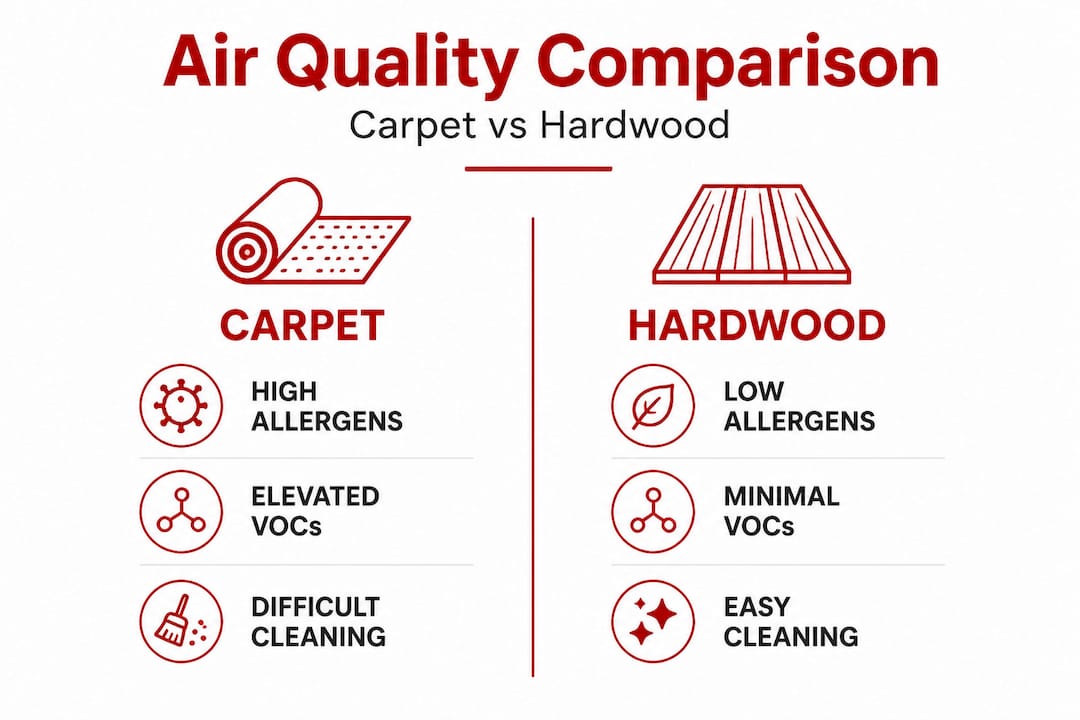
Carpet is the most common offender. Its fibers trap particles like a net, collecting dust mites, pet dander, mold spores, and bacteria deep within the pile. Vacuuming helps, but it never fully removes what’s buried at the base of the carpet. Over time, foot traffic kicks those particles back into the air, where you and your family breathe them in.
| Flooring type | Allergen/dust retention | VOC emission risk | Ease of cleaning |
|---|---|---|---|
| Carpet | Very high | Moderate (from backing/adhesives) | Low |
| Laminate | Low | High (formaldehyde from core) | Moderate |
| Vinyl/LVP | Low | Moderate to high | High |
| Hardwood | Very low | Low (with low-VOC finishes) | High |
| Engineered hardwood | Very low | Low to moderate (cert. dependent) | High |
Carpet traps significantly more dust and allergens than hard surfaces, making hardwood easier to maintain and far more effective at keeping airborne particle counts low. A simple sweep or damp mop removes what’s there, rather than just redistributing it.
Laminate flooring often seems like a budget-friendly alternative to hardwood, but many laminate products use dense fiberboard cores bonded with urea-formaldehyde adhesives. These can release formaldehyde gas for months or even years, particularly in warm or humid conditions. Learn more about allergy-proof flooring comparisons before making a final decision.
The impact of wood flooring extends beyond allergies. Families with asthma who switch from carpet to hardwood often notice fewer flare-ups within weeks, simply because there are fewer triggering particles floating around.
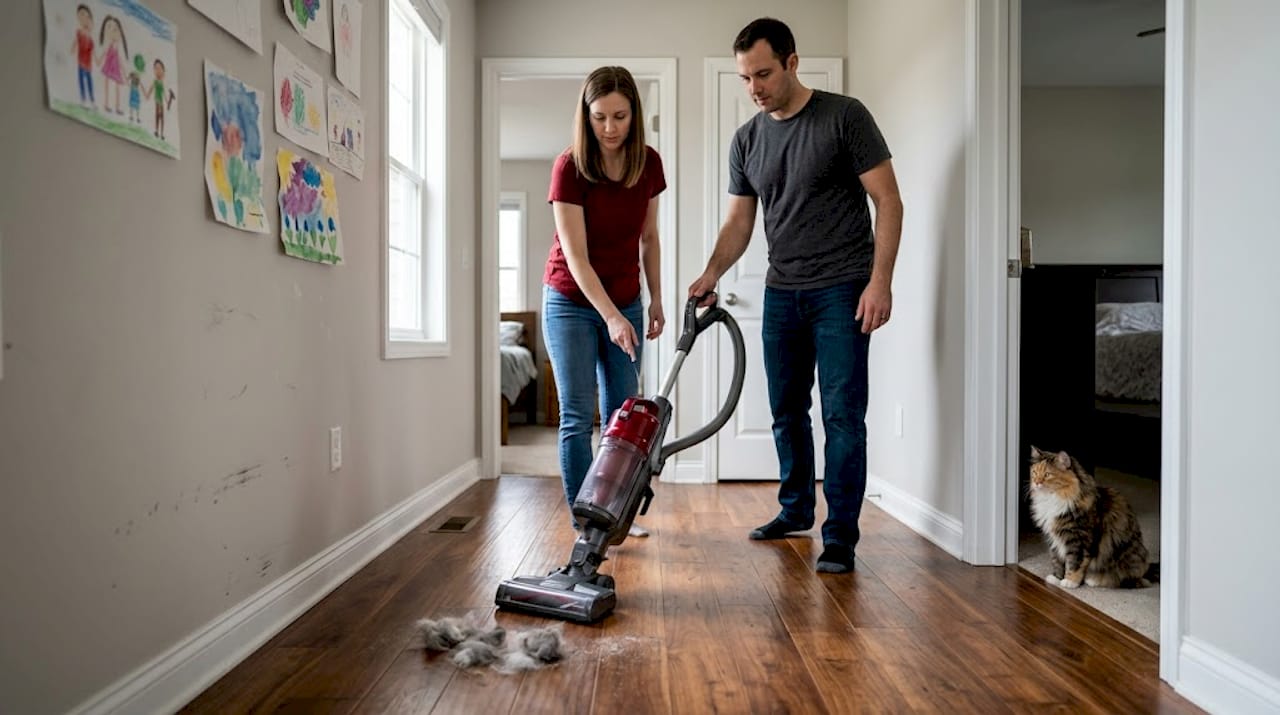
Pro Tip: If you have pets, hardwood is especially beneficial. Pet dander and fur sit on the surface and wipe away quickly, rather than embedding deep into fibers where standard cleaning can’t reach.
What makes hardwood a healthier flooring option
Not all hardwood floors are created equal when it comes to air quality. The material itself matters, but so do the finishes applied to it and the certifications on the box.
Solid hardwood in its unfinished state is naturally low in VOC risk. It’s a single piece of real wood, with no adhesives or composite materials. The main VOC exposure with solid hardwood comes from the finish applied on top, which is why low-VOC options are essential.
Engineered hardwood uses multiple layers of wood bonded together with adhesives, which is where formaldehyde risk can enter the picture. Engineered products must comply with CARB Phase 2 standards, which set a formaldehyde limit of 0.05 parts per million for hardwood plywood composites. Without that certification, you may be introducing a significant emissions source into your living space.
Choosing certified flooring grades and certifications gives you the confidence that what you’re installing meets a rigorous health standard. The EPA’s VOC guidance makes clear that low-VOC finishes and CARB Phase 2 or TSCA Title VI compliance are the benchmarks for health-conscious choices.
When shopping for hardwood, look for these IAQ-friendly indicators:
- CARB Phase 2 or TSCA Title VI compliance on engineered products
- FloorScore or GREENGUARD Gold certification, which test finished flooring for VOC emissions
- Low-VOC or water-based finish applied at the factory or on-site
- No added urea-formaldehyde (NAUF) adhesives in the core layers
- Third-party testing documentation available from the manufacturer
| Certification | What it covers | Why it matters |
|---|---|---|
| CARB Phase 2 | Formaldehyde in composite wood | Limits formaldehyde to 0.05 ppm |
| TSCA Title VI | Formaldehyde in imported composite wood | Federal standard equivalent to CARB Phase 2 |
| FloorScore | VOC emissions from finished flooring | Ensures low total VOC off-gassing |
| GREENGUARD Gold | Broader chemical emissions in products | Required for schools/healthcare, excellent for homes |
Browse engineered hardwood options that meet these standards and offer a solid balance between performance and health safety.
Pro Tip: Ask your flooring supplier for the specific certification documentation before you buy. A reputable supplier will have it on hand. If they can’t produce it, that’s a red flag worth taking seriously.
VOC emissions and what to expect during installation and refinishing
Even with the healthiest flooring product on the market, the installation process can introduce a short-term spike in VOC levels. Knowing what to expect helps you plan ahead and protect your household.
During installation, adhesives, stains, and sealers can all off-gas into your home. The first 24 to 72 hours typically see the highest concentration of emissions, especially if strong-solvent products were used. After that, levels generally drop significantly, though some products continue to off-gas at lower rates for several weeks. Good installation job preparation includes planning for this window.
Refinishing is actually the greater short-term risk. Sanding and staining during refinishing releases a concentrated burst of VOCs as the old finish is broken up and new products are applied. If you’ve ever refinished floors and noticed a sharp chemical smell that lingers, that’s exactly what’s happening.
Here are the practical steps to protect your air quality during and after installation or refinishing:
- Choose low-VOC or water-based products for adhesives, stains, and topcoats from the start.
- Open all windows and doors before work begins and keep them open throughout the process.
- Run exhaust fans in bathrooms and kitchens to pull air out of the space.
- Vacate the home for at least 24 to 48 hours after work completes, especially with children and pets.
- Continue ventilating for 72 hours post-installation, even if odors have faded.
- Test indoor air quality if you have significant health concerns or notice persistent symptoms after moving back in.
Ventilate after installation or refinishing, maintain humidity between 30 and 50%, and use air purifiers if needed to bring VOC levels back to a healthy baseline quickly.
Review these wood floor installation tips before your project starts so you’re not scrambling during an already disruptive process.
Maintenance tips to keep your air (and floors) clean
The installation phase is temporary. Your maintenance habits are what determine your indoor air quality for years to come. The good news is that hardwood floors make the healthy choice the easy choice.
Here’s what a sustainable, air-friendly maintenance routine looks like:
- Sweep or dust mop daily in high-traffic areas to prevent particle buildup before it can become airborne
- Use a damp mop weekly with a cleaner designed for hardwood, avoiding excess moisture that can cause warping or mold
- Replace HVAC filters every 60 to 90 days to remove particles before they recirculate through your home
- Use a HEPA-filter vacuum at least once a week, particularly near rugs, entryways, and under furniture
- Remove shoes at the door to prevent outdoor pollutants, pesticides, and pollen from being tracked inside
- Place washable mats at all entry points to capture what shoes bring in before it reaches your floors
Humidity control is one of the most overlooked factors in both floor care and air quality. Keeping indoor humidity between 30 and 50% does double duty. It prevents wood from swelling or gapping, and it keeps mold and dust mites from thriving. Both mold spores and dust mites need higher moisture levels to multiply, so controlling humidity cuts off their food supply.
Refer to this humidity control guide for floors for specific recommendations based on your climate zone and home type.
Pro Tip: Consider adding a whole-home air purifier with a HEPA and activated carbon filter. Hardwood floors reduce particle load dramatically, but an air purifier catches what sweeping misses and neutralizes residual VOCs year-round.
When should you test your indoor air quality? If you or a family member experiences persistent headaches, irritated eyes, or worsening allergy symptoms despite a clean home, an air quality test kit or professional assessment can identify whether VOC levels or particle counts are elevated. These tests are inexpensive and can reveal problems that aren’t visible to the naked eye.
A hard-won lesson: Why air quality with hardwood is more than just the material
Here’s something the flooring industry doesn’t say loudly enough. Choosing hardwood does not automatically guarantee clean air. We’ve seen homeowners invest in beautiful solid oak floors, then pair them with a high-VOC oil-based finish and a solvent-heavy adhesive. The result? A floor that looks stunning but off-gasses for months.
The material is only part of the equation. Every decision in the chain matters. How the floor was manufactured, what adhesives and finishes were used, how the installation was handled, and how the home is maintained afterward all determine whether your hardwood floors become a genuine air quality asset or a neutral choice at best.
There’s also a nuance worth knowing about natural wood itself. Even untreated wood emits terpenes and natural VOCs, though at far lower concentrations than synthetic flooring materials. Using low-VOC finishes and treatments significantly reduces total emissions, even when compared to bare wood. That means the finish you choose on top of your hardwood can meaningfully lower your home’s overall VOC load.
Our perspective, after working with homeowners across a wide range of budgets and health priorities, is that the biggest gains come from three combined actions. Choose certified, low-emission products. Invest in a clean, well-ventilated installation. Then commit to a maintenance routine that keeps particles off the surface before they become airborne. None of these steps alone is sufficient, but together, they make a real and lasting difference in the air your family breathes every day.
Homeowners who approach this proactively, rather than just buying a floor and hoping for the best, consistently report fewer allergy symptoms, fresher-feeling homes, and more confidence in their indoor environment.
Find your healthy hardwood flooring solution
Making the shift to healthier indoor air starts with the right floor, and that means choosing certified, low-emission products from a supplier who actually cares about what they sell.
At Kapriz Hardwood Floors, every product in our catalog meets our own quality standards. We carry options that span high-end to budget-friendly, and all of them are solid value for real homes. Whether you want to shop hardwood floors from trusted brands, find affordable Bay Area flooring that doesn’t cut corners on certification, or get guidance on how to choose durable hardwood that will last decades, we’re here to help you make the best decision for your home and your health.
Frequently asked questions
What type of hardwood flooring is best for air quality?
Solid hardwood or certified engineered hardwood with low-VOC finishes and CARB Phase 2 or TSCA Title VI compliance delivers the best indoor air quality results. These options minimize formaldehyde and chemical off-gassing from the start.
How long should I ventilate after installing or refinishing hardwood floors?
Ventilate for at least 48 to 72 hours after installation or refinishing to allow VOC concentrations to drop to safe levels. Keep windows open and fans running throughout that period.
Do hardwood floors improve allergy symptoms compared to carpet?
Yes, because hardwood doesn’t trap allergens and pet dander the way carpet fibers do, particles stay on the surface where they’re easy to clean rather than embedding into the floor and becoming airborne again.
Can refinishing hardwood floors worsen indoor air temporarily?
Yes. Sanding and staining release concentrated VOCs during refinishing, causing a short-term dip in air quality. Plan for proper ventilation and vacate the space for at least 24 to 48 hours.
What ongoing maintenance helps keep air healthy with hardwood floors?
Regular sweeping, damp mopping, and keeping humidity at 30 to 50% prevent particle buildup and inhibit mold and dust mite growth, sustaining both clean air and long-lasting floors.
Recommended
- How Can I Boost Home Value with Top Hardwood Flooring Picks for ROI | Kapriz Hardwood Flooring Store
- Why Hardwood Floors Boost Bay Area Home Resale Value
- Allergy-Proof Floors – Why Hardwood Crushes Carpet (and Beats Laminate Too) | Kapriz Hardwood Flooring Store
- Wood Flooring Throughout the House | Kapriz Hardwood Flooring Store


