

Site-finished hardwood: benefits, process & Bay Area tips
TL;DR:
- Site-finished hardwood floors are installed as raw wood and finished on-site for customization.
- They offer seamless appearance and easier repairability compared to prefinished flooring.
- Proper installation and finishing are critical, especially considering Bay Area climate and humidity conditions.
Most homeowners assume hardwood flooring arrives at the job site ready to go, straight from the factory, already beautiful and sealed. That assumption leads a lot of Bay Area buyers toward prefinished options without ever considering what they’re giving up. Site-finished hardwood is a different approach entirely, one where raw wood planks are installed first and then sanded, stained, and coated right in your home. The result is a floor that’s completely yours. This article walks you through the full process, the real benefits, how it compares to prefinished flooring, and what local homeowners specifically need to think about before making a decision.
Table of Contents
- What is site-finished hardwood?
- Benefits of site-finished hardwood floors
- Site-finished vs. prefinished hardwood: Key differences
- Considerations for Bay Area homes
- Why the site-finished approach is still a smart choice
- Explore your hardwood flooring options with Kapriz
- Frequently asked questions
Key Takeaways
| Point | Details |
|---|---|
| Custom finish options | Site-finished hardwood offers unlimited customization for color, texture, and sheen. |
| Seamless appearance | The flooring is installed, sanded, and finished on-site for a smooth, gap-free look. |
| Long-term durability | Site-finished hardwood floors are highly durable and easy to repair or refinish. |
| Bay Area considerations | Local climate and style trends make professional finishing a smart investment for homeowners. |
What is site-finished hardwood?
Site-finished hardwood starts as raw, unfinished wood planks. Unlike prefinished flooring, which comes coated and ready to install, site-finished boards arrive bare. They go down first, and then all the finishing work happens in your home. As noted in a 2026 homeowner guide, site-finished hardwood floors are sanded and finished on-site, allowing for customization that factory production simply can’t offer.
The process follows a clear sequence. After installation preparation is complete, the planks are nailed, glued, or floated depending on the subfloor and wood species. Once the boards are down and acclimated, a professional sands the entire surface to create a perfectly flat, uniform plane. Then comes staining (if desired), followed by multiple coats of finish, with drying time between each coat.
This is where the real magic happens. Because the finish is applied after installation, every plank becomes part of one continuous surface. There are no gaps between boards where finish was cut off at the factory edge. The floor reads as a single, flowing piece of wood.
Here’s a quick overview of the main steps:
- Acclimation: Raw boards sit in your home for several days to adjust to local humidity levels
- Installation: Boards are fastened using your chosen hardwood installation method
- Sanding: Multiple passes with progressively finer grits create a smooth, level surface
- Staining: Optional color application to match your design vision
- Finishing: Two to four coats of oil-based or water-based polyurethane, or a hardwax oil
- Curing: Full hardness is reached after several days to a couple of weeks
The table below shows what each phase involves and roughly how long it takes:
| Phase | What happens | Approximate time |
|---|---|---|
| Acclimation | Wood adjusts to home environment | 3 to 7 days |
| Installation | Boards fastened to subfloor | 1 to 2 days |
| Sanding | Surface leveled and smoothed | 1 day |
| Staining and finishing | Color and protective coats applied | 2 to 4 days |
| Curing | Finish hardens fully | 5 to 14 days |
This process requires professional-grade drum sanders, edge sanders, and buffer machines. It also demands real skill. Done right, the result is a floor that looks like it grew out of your home.
Benefits of site-finished hardwood floors
Now that you understand the process, let’s look at why so many homeowners still choose this approach over the faster, factory-finished alternative.
The most talked-about benefit is the seamless appearance. Because the finish is applied across the entire installed floor, there are no microbevels. Microbevels are the tiny angled edges built into prefinished planks to hide installation gaps. On a site-finished floor, boards meet edge to edge with no visual interruption. The result looks cleaner, especially in open-plan spaces or rooms with strong natural light.
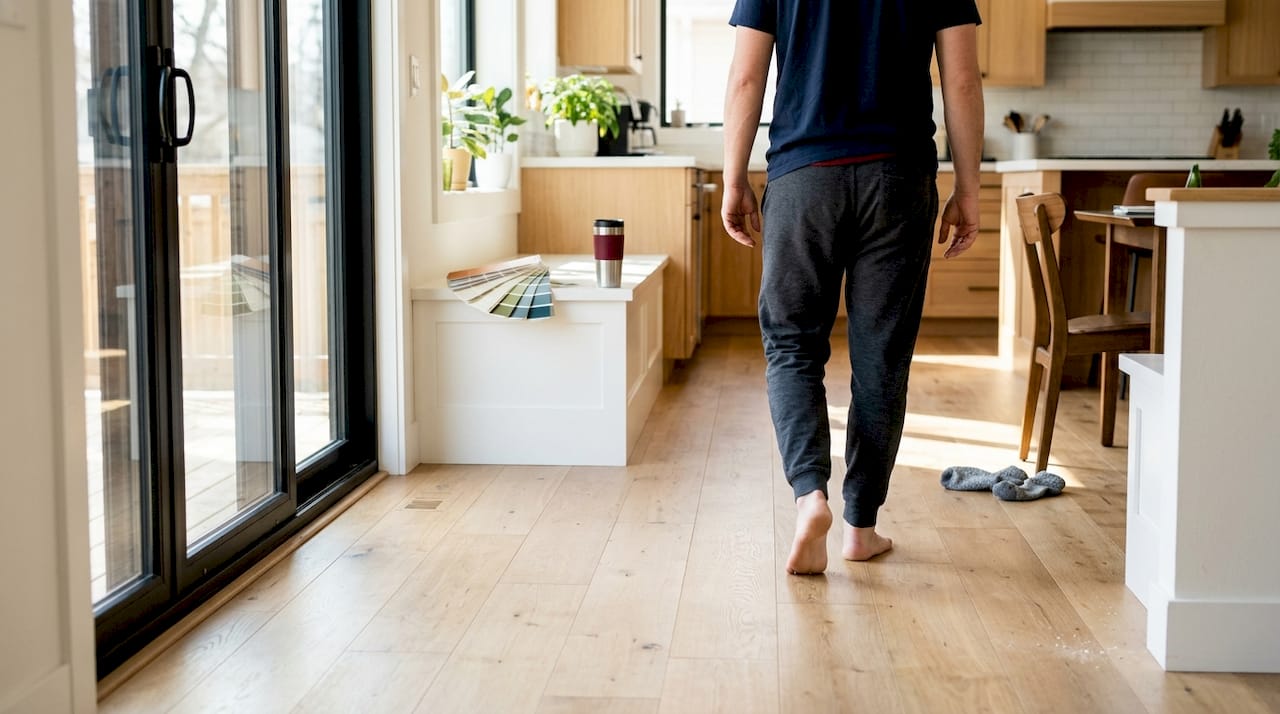
You also get complete control over the final look. Want a matte, wire-brushed gray that matches your kitchen cabinets? Done. Prefer a warm amber stain with a satin sheen? No problem. The latest hardwood styles show just how varied the options have become, and site-finished floors can replicate almost any of them. Prefinished floors lock you into whatever the factory decided to produce that season.
As highlighted in a 2026 guide for homeowners, site-finished hardwood offers greater customization and a seamless appearance that prefinished options can’t match. That’s not marketing language. It’s a structural reality of how the two products are made.
Long-term repairability is another strong point. If a section of your floor gets scratched or damaged years down the road, a skilled installer can sand and refinish just that area without the repair looking patched. The finish blends because it was applied as one coat across the whole floor.
Potential drawbacks to keep in mind:
- The process takes longer than installing prefinished flooring
- You may need to vacate the space during sanding and finishing due to dust and fumes
- Costs can run higher upfront due to labor and materials
- Finish quality depends heavily on the installer’s skill level
Pro Tip: If you’re browsing modern styles for Bay Area homes and find a look you love, bring photos to your flooring professional. A skilled finisher can often replicate that exact stain and sheen combination on-site, giving you a custom result at a fraction of what a specialty product might cost.
| Feature | Site-finished | Prefinished |
|---|---|---|
| Appearance | Seamless, no microbevels | Beveled edges visible |
| Customization | Full control over stain and sheen | Limited to factory options |
| Installation speed | Slower (multi-day process) | Faster (ready to walk on) |
| Repairability | Easier to blend repairs | Harder to match factory finish |
| Disruption | Higher (dust, fumes, vacate) | Lower |
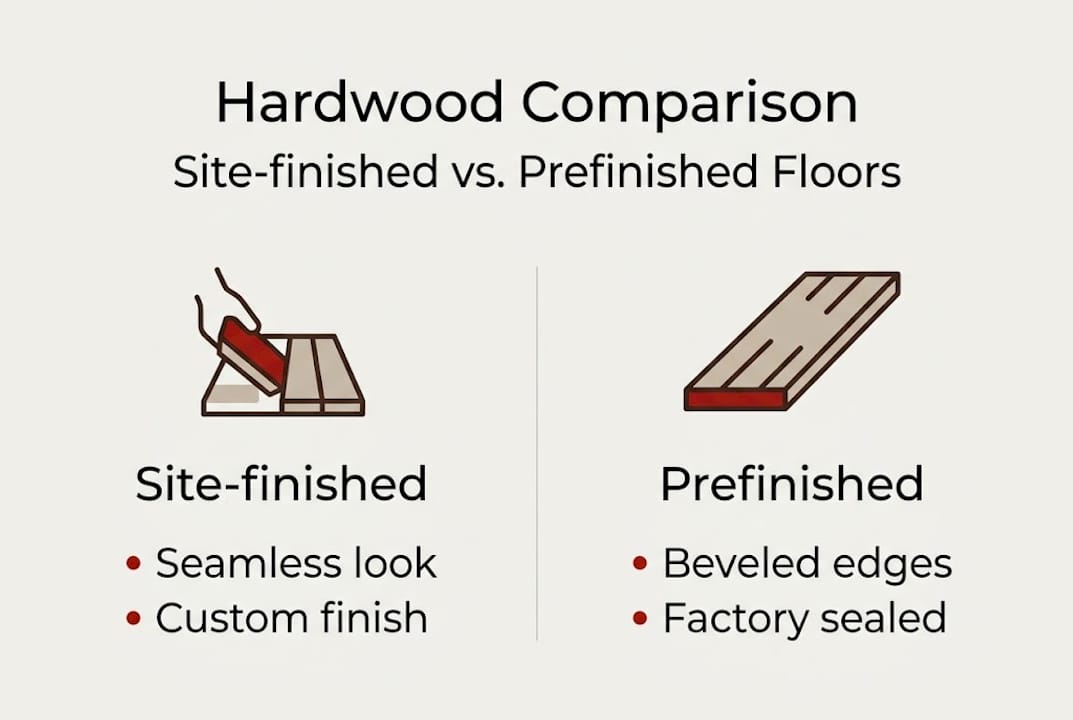
Site-finished vs. prefinished hardwood: Key differences
To help you choose confidently, let’s break down the differences between these two options side by side.
Prefinished hardwood is finished in a factory under controlled conditions. The finish is applied using UV-cured aluminum oxide coatings, which are extremely hard and scratch-resistant. As explained in a 2026 homeowner guide, prefinished hardwood is factory-produced with durable finishes, while site-finished offers flexibility that the factory process can’t replicate.
Here’s how the two options stack up across the factors that matter most:
| Factor | Site-finished | Prefinished |
|---|---|---|
| Finish durability | Good to excellent (depends on product) | Excellent (UV-cured aluminum oxide) |
| Visual continuity | Seamless surface | Visible beveled edges |
| Custom color options | Unlimited | Limited to manufacturer palette |
| Time to use floor | 1 to 2 weeks total | Same day or next day |
| Long-term refinishing | Easy, multiple times | More difficult, fewer cycles |
| Upfront cost | Higher labor cost | Lower installation cost |
A few things worth knowing before you decide:
- Factory finishes are harder on day one. UV-cured coatings are genuinely tougher than most site-applied finishes right out of the gate. If you have heavy foot traffic or pets, this matters.
- Site-finished floors age more gracefully. Because the finish can be sanded and recoated uniformly, a site-finished floor can look brand new after refinishing in a way that prefinished floors often can’t.
- The beveled edge issue is real. Over time, dirt and debris collect in those tiny grooves between prefinished planks. On a site-finished floor, there’s nowhere for that to happen.
- Installation timelines affect your life. If you’re renovating while living in the home, the multi-day process for site-finished floors means more disruption. Check out prefinished flooring trends if speed is your top priority.
For a deeper look at working with prefinished products, the prefinished flooring guide covers what to expect during and after installation.
One often-overlooked stat: hardwood floors that are properly maintained can last 100 years or more. The finish type you choose at installation affects how many refinishing cycles you’ll get over that lifetime, and site-finished floors generally allow more of them.
Considerations for Bay Area homes
After comparing options, let’s get practical. The Bay Area has a climate that’s genuinely different from most of the country, and that affects how hardwood performs.
The region sees mild but variable conditions. Coastal areas like San Francisco and Daly City deal with higher humidity and marine air. Inland spots like Walnut Creek or Fremont get hotter, drier summers. These swings in moisture cause wood to expand and contract. If a floor isn’t properly acclimated or the finish isn’t suited to local conditions, you can end up with cupping, gapping, or surface cracking.
As documented in a guide on common hardwood issues, Bay Area climate can affect hardwood performance, making professional installation critical for long-term results.
For local homes, water-based polyurethane finishes are often a smart call. They dry faster, emit fewer fumes, and hold up well in moderately humid environments. Oil-based finishes offer a warmer amber tone and are extremely durable, but they take longer to cure and off-gas more during the process.
“The best finish for a Bay Area home is the one that fits both the climate and the lifestyle of the people living there. There’s no one-size answer.”
Practical tips for Bay Area homeowners:
- Acclimate your raw wood for at least five days before installation, especially in coastal zip codes
- Use a moisture meter to check both the subfloor and the wood before any boards go down
- Schedule installation during mild weather, not during the peak of summer heat
- Ask your installer about hardwood maintenance tips specific to your neighborhood’s humidity profile
- Keep indoor humidity between 35% and 55% year-round using a humidifier or dehumidifier as needed
Pro Tip: Plan your installation during a stretch when you can stay elsewhere for three to five days. The sanding and finishing phases generate fine dust and strong fumes. Getting out of the house isn’t just more comfortable, it protects your health and lets the finish cure without foot traffic disturbing it.
Why the site-finished approach is still a smart choice
Here’s an honest take: the rise of prefinished flooring has made a lot of people assume site-finished is outdated. It’s not. It’s just different, and for the right home, it’s still the better choice.
We’ve seen this play out on real Bay Area projects. Older craftsman homes, open loft conversions, and high-design new builds all share one thing: they need a floor that feels intentional, not off-the-shelf. Site-finished hardwood delivers that. You can match an existing floor in an older home perfectly because the stain is mixed and applied on-site. You can create a custom color that no factory produces. You can follow luxury hardwood trends without being locked into what a manufacturer decided to stock.
The long-term repairability argument is also underrated. A floor that can be sanded and refinished four or five times over its life is a floor that can outlast the house itself. That’s not an exaggeration. It’s a real financial and design advantage that prefinished floors, with their thinner wear layers, often can’t match.
Site-finished hardwood asks more of you upfront: more time, more planning, more disruption. But it gives back more too.
Explore your hardwood flooring options with Kapriz
If you’re ready to transform your space, here’s how Kapriz can help you choose the right hardwood flooring. At Kapriz Hardwood Floors, we carry both site-finished and prefinished options across a wide range of species, colors, and price points. Whether you’re working with a tight budget or going all-in on a luxury remodel, we have something that fits.
Browse our full hardwood flooring selections to see what’s available for Bay Area homes. If durability is your main concern, our durable flooring guide walks through the best options for local conditions. And if you’re thinking about wood flooring throughout the house, we can help you plan a cohesive look from room to room. Come talk to us. We know these floors, and we know this region.
Frequently asked questions
How long does it take to install site-finished hardwood floors?
Installation of site-finished hardwood requires sanding, staining, and finishing on location, so the full process typically takes five to ten days from start to finish, depending on room size and complexity.
Is site-finished hardwood more durable than prefinished hardwood?
Site-finished floors allow customized durability based on the finish you choose, and they’re easier to repair over time, though factory UV-cured finishes on prefinished floors are often harder on day one.
Are site-finished hardwood floors a good choice for homes in the Bay Area?
Yes, particularly when a professional handles installation and selects a finish suited to local humidity. Bay Area climate can affect hardwood performance, so proper acclimation and finish selection matter a lot.
Can site-finished hardwood be refinished multiple times?
Site-finished floors are easier to sand and refinish compared to prefinished options, and most can be refinished four to six times over their lifespan, significantly extending the floor’s useful life.
Recommended
- Bay Area hardwood DIY guide: 5 steps to success | Kapriz Hardwood Flooring Store
- Best Hardwood Floor Finishing Options for Value and Durability | Kapriz Hardwood Flooring Store
- Hardwood flooring pros and cons: Bay Area homeowner’s guide | Kapriz Hardwood Flooring Store
- How to choose hardwood floors for your Bay Area home | Kapriz Hardwood Flooring Store

