

Protect Your Hardwood Floors: Expert Humidity Control Guide
TL;DR:
- Indoor humidity swings cause significant damage like cupping and gaps in hardwood floors.
- Using engineered hardwood and proper climate control measures helps prevent moisture-related issues.
- Active humidity management with hygrometers, dehumidifiers, and proper installation prolongs hardwood floor lifespan.
Many Bay Area homeowners assume that once their hardwood floors are installed, the hard work is done. It isn’t. Between the foggy summers in the Sunset District and the bone-dry heat of Walnut Creek, indoor humidity can shift dramatically in a matter of days. Those swings stress your wood constantly, and hardwood floors expand and contract with every change in relative humidity. The result? Visible cupping, gaps between planks, or crowned boards that no amount of refinishing will fix. This guide breaks down exactly why humidity matters, how your specific flooring type responds, and what you can do right now to keep your floors looking great for decades.
Table of Contents
- Why humidity matters for hardwood floors
- How different hardwood types respond to humidity
- Effective humidity control strategies for Bay Area homes
- Installation and maintenance: Preventing humidity disasters
- The truth most people miss about humidity and hardwood
- Find expert hardwood floor solutions for Bay Area humidity
- Frequently asked questions
Key Takeaways
| Point | Details |
|---|---|
| Humidity impacts hardwood | Seasonal changes in Bay Area indoor moisture can cause visible floor damage if not controlled. |
| Species and construction matter | Choosing stable wood types or engineered products helps reduce risk from humidity swings. |
| Active control is essential | Regular monitoring and using humidifiers or dehumidifiers keep your floors protected year-round. |
| Proper installation is key | Acclimating and preparing wood before install prevents many future problems. |
Why humidity matters for hardwood floors
Wood is a living material, even after it’s been milled, dried, and installed on your subfloor. It still absorbs and releases moisture from the air around it. When indoor relative humidity (RH) rises, wood fibers swell. When RH drops, those fibers shrink. Do that enough times in a short enough window, and you get structural problems that go well beyond cosmetic.
The Bay Area’s microclimates make this especially tricky. A home in Daly City might sit at 75% RH on a foggy August morning, while a home in Concord hits 35% on a dry October afternoon. Indoor humidity can swing 20% or more between seasons, and sometimes between weeks. That kind of stress adds up fast.
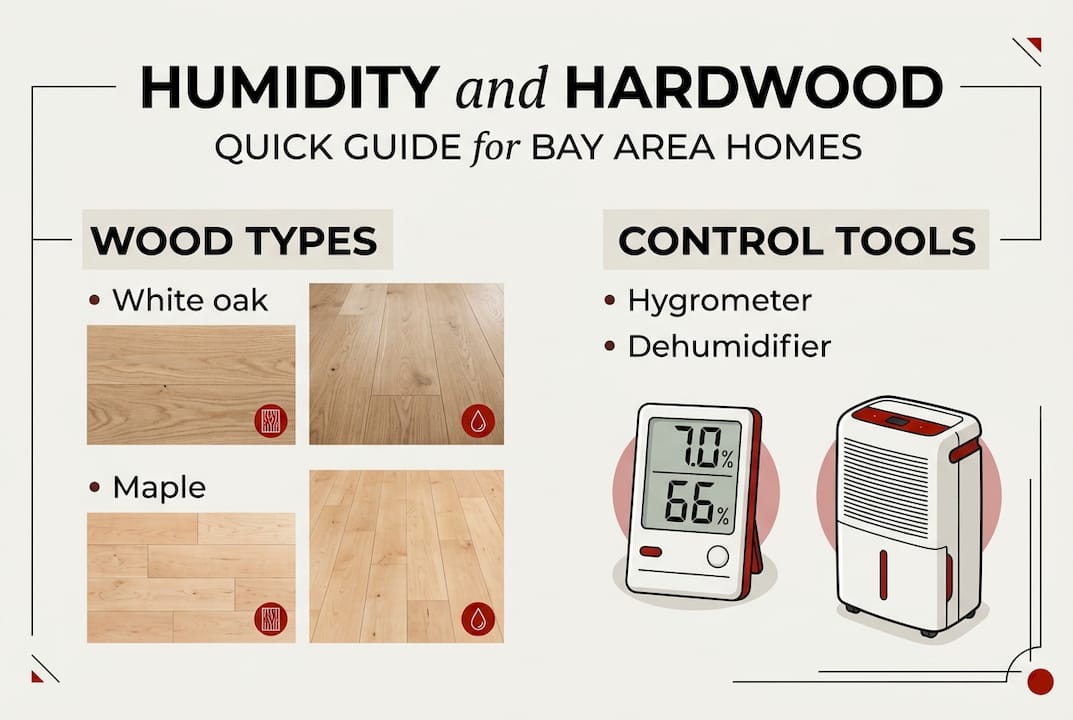
Here’s a quick look at what different humidity levels actually do to your floors:
| Relative humidity | Wood behavior | Risk level |
|---|---|---|
| Below 30% | Shrinks, gaps form between boards | High |
| 30% to 35% | Slight shrinkage, minor cracking possible | Moderate |
| 35% to 55% | Stable, minimal movement | Ideal |
| 56% to 70% | Swelling, cupping begins | Moderate |
| Above 70% | Severe cupping, crowning, mold risk | High |
“Visible cupping or gapping can appear within just a few days of significant humidity shifts, especially in thinner or unfinished boards.” According to NWFA maintenance standards, consistent climate control is one of the most important factors in long-term floor performance.
This is not a slow, gradual process. Damage can show up fast. Most homeowners don’t notice a problem until it’s already baked in, and by then, the repair costs can rival the original installation price. Understanding what’s at stake is the first step toward protecting your investment.
Now that you understand what’s at stake, let’s uncover exactly how humidity interacts with your hardwood flooring.
How different hardwood types respond to humidity
Not all hardwood is equally vulnerable. The species you choose and the construction method used both play a major role in how your floors hold up through the Bay Area’s wet winters and dry spells.
Some wood species and engineered products are significantly more dimensionally stable in varying conditions. Solid hardwood, for example, is milled from a single piece of wood and is highly responsive to moisture changes. Engineered hardwood uses a real wood veneer bonded over a plywood or HDF core, which resists warping far better because the layers counteract each other’s movement.
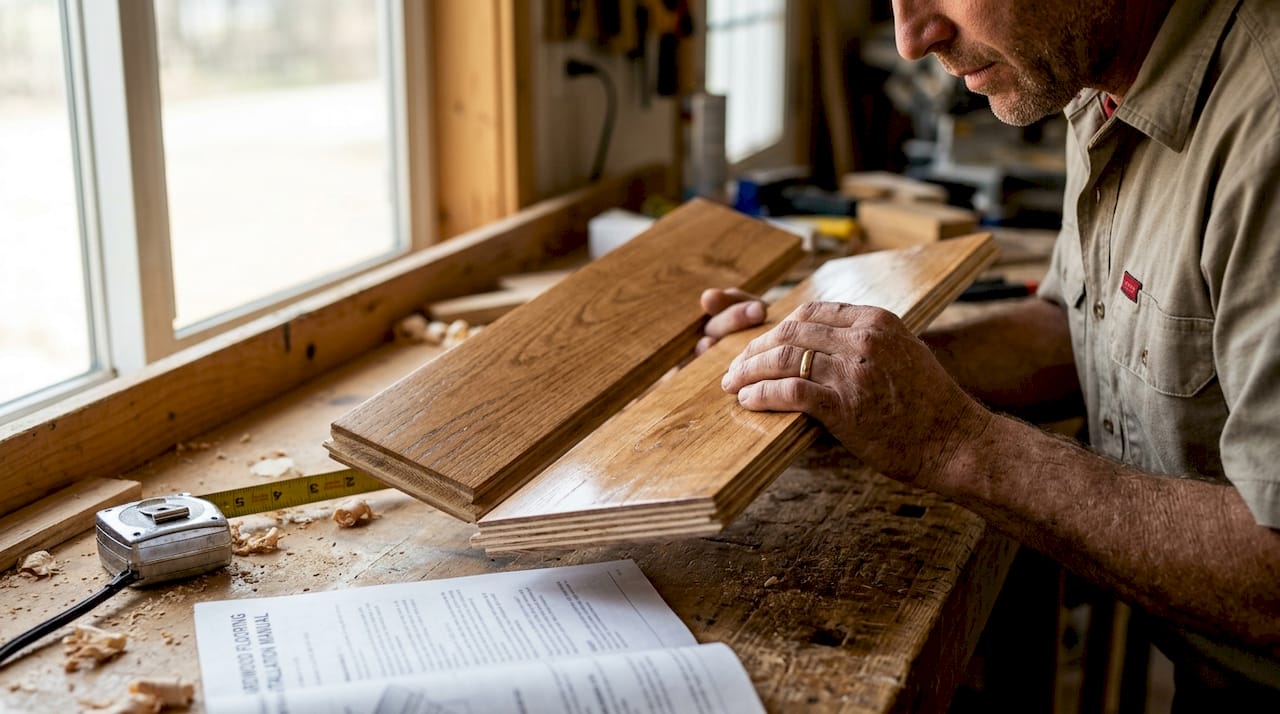
Here’s how some popular species stack up:
| Species | Janka hardness | Moisture sensitivity | Bay Area suitability |
|---|---|---|---|
| White oak | 1360 | Low to moderate | Excellent |
| Maple | 1450 | Moderate | Good |
| Brazilian cherry | 2820 | Low | Very good |
| Pine | 870 | High | Poor |
| Hickory | 1820 | Moderate | Good |
For a deeper breakdown of wood species for Bay Area homes, white oak stands out as a consistent performer. It moves less than red oak and holds up well to seasonal shifts. If you want more options, reviewing the best wood species available for different performance goals is a smart starting point.
For a full overview of construction options, including solid, engineered, and acrylic-infused boards, explore the range of hardwood flooring types suited to every budget.
When shopping for floors in a humidity-prone area, prioritize these features:
- Engineered construction for rooms with variable humidity
- Wider boards only if paired with proper climate control (wider boards move more)
- Oil or aluminum oxide finishes that seal the surface and slow moisture absorption
- Species with lower shrinkage coefficients, like white oak or Brazilian cherry
- Thicker wear layers on engineered products if you ever want to refinish
For detailed information on hardwood flooring construction methods, comparing solid versus engineered side by side helps clarify which format fits your specific rooms.
Pro Tip: Opt for engineered hardwood in any room that faces the outside, sits above a crawl space, or experiences seasonal drafts. The layered core dramatically reduces the risk of cupping.
Knowing that not all hardwoods are created equal, let’s compare how specific control strategies can make a real difference.
Effective humidity control strategies for Bay Area homes
You cannot rely on passive conditions to protect your floors. The Bay Area’s climate requires active management, and the good news is that the tools are accessible and affordable.
The target range is clear: maintaining 35 to 55% indoor humidity is ideal for hardwood longevity. Everything you do should be aimed at keeping your home inside that window year-round.
Here are the steps to build a reliable humidity control routine:
- Install a digital hygrometer in each main living area. These cost as little as $15 and give you real-time RH readings. You cannot manage what you don’t measure.
- Run a dehumidifier during wet months. From November through March, Bay Area homes often push past 60% RH. A quality dehumidifier set to 50% will handle most of the work automatically.
- Use a humidifier in dry stretches. When Santa Ana winds or inland heat waves push your indoor RH below 35%, a whole-home or portable humidifier prevents shrinkage and cracking.
- Adjust your HVAC settings seasonally. Many modern systems include humidity controls. Set yours to maintain 45 to 50% RH as a baseline and let it work in the background.
- Fix leaks and improve ventilation promptly. Under-sink leaks, a poorly sealed bathroom, or a damp crawl space all drive RH up in localized areas. Address these immediately.
- Check your indoor air quality guidelines annually. The EPA recommends keeping RH below 60% to discourage mold, which overlaps directly with what your floors need.
For anyone planning a new installation, preparing your home for hardwood involves getting these systems in place before the wood ever arrives.
Pro Tip: Always acclimate new wood flooring for at least 72 hours in the room where it will be installed. Stack the boards loosely, leave the HVAC running at normal settings, and let the wood reach equilibrium with your home’s actual conditions before a single nail goes in.
With the right materials and climate strategy in mind, let’s cover the installation and maintenance practices that complete the picture.
Installation and maintenance: Preventing humidity disasters
Even the best wood species and the most diligent humidity monitoring can be undone by poor installation. In the Bay Area, subfloor preparation is not a step you rush.
Moisture barriers are mandatory on concrete slabs, especially in homes near the coast or above unconditioned crawl spaces. A proper vapor barrier limits moisture migration from below, which is one of the sneakiest sources of RH imbalance. Proper acclimation and subfloor preparation are what separate a 30-year floor from one that starts cupping in year two.
Before installation begins, review these job preparation steps to make sure your space is truly ready. If you’re working over concrete, the process for preparing a concrete slab requires specific testing and sealing that goes beyond what most DIY guides cover.
For ongoing care, the hardwood upkeep advice from the National Wood Flooring Association is a solid reference for keeping floors performing year after year.
Common mistakes that lead to humidity damage:
- Skipping the moisture meter test on the subfloor before installation
- Not acclimating the wood in the actual installation room and conditions
- Installing over a wet slab without a proper moisture barrier
- Leaving gaps around baseboards that allow humid air to flow under the floor
- Using excessive water when cleaning, which pushes moisture between planks
- Ignoring seasonal RH checks once the floor looks fine
Pro Tip: Scheduling a seasonal inspection, one in late fall and one in early spring, helps catch minor humidity problems before they become expensive repairs. Look for slight cupping, gaps wider than a credit card, or any soft spots that indicate moisture below the surface.
The truth most people miss about humidity and hardwood
Here’s the part that most flooring articles gloss over. Homeowners spend weeks agonizing over species, finish color, and price per square foot. Those decisions matter, but they are secondary. We’ve seen premium white oak installations cup badly within six months because the home had no active humidity management. We’ve also seen budget-friendly engineered oak from a decade ago still looking perfect because the homeowner ran a dehumidifier and kept a hygrometer on the wall.
The wood itself is rarely the failure point. The environment is.
Many Bay Area homeowners treat humidity control as a reactive measure, something you think about after you see damage. That’s exactly backwards. The most expensive mistake you can make is waiting. Humidity damage is cumulative. Each cycle of swelling and shrinking weakens the board’s structure, loosens adhesives, and drives moisture deeper into the subfloor. By the time you see a cupped plank, the problem has usually been building for months.
Start with in-depth humidity tips before your floors go in, not after. Climate control is not a luxury add-on. It’s the foundation everything else rests on.
Find expert hardwood floor solutions for Bay Area humidity
Choosing the right floor for the Bay Area’s unique climate takes more than reading a product label. It takes experience with local conditions, knowledge of which species and constructions actually hold up, and honest guidance on what fits your budget without cutting corners on performance.
At Kapriz Hardwood Floors, we work with Bay Area homeowners every day to match them with flooring that’s built for real-world conditions, not just showroom lighting. Whether you want to browse hardwood floor options across a wide range of styles and price points, or explore our curated solid hardwood collection for high-performance spaces, our team can help you find the right fit. Beautiful, durable floors are possible at every budget. Let us show you how.
Frequently asked questions
What is the ideal indoor humidity level for hardwood floors?
The ideal indoor humidity for hardwood is between 35% and 55% to prevent expansion and contraction issues that cause cupping, gapping, or crowning.
Can I use a dehumidifier to protect my hardwood floors in the Bay Area?
Yes, a dehumidifier is one of the most effective tools for controlling excess moisture and is especially recommended during the Bay Area’s wet season, when indoor humidity spikes past 60% are common.
Should new hardwood floors be acclimated before installation?
Always acclimate new hardwood for at least 72 hours in the installation room. Proper acclimation allows the wood to adjust to your home’s actual humidity and temperature before it’s fastened down.
How quickly can humidity changes damage hardwood floors?
Noticeable cupping or gapping can appear within days of a large humidity shift. Because hardwood expands and contracts with every RH change, even short unprotected stretches can lead to lasting structural problems.
Recommended
- Exposing the waterproof hardwood myth: what buyers need to know | Kapriz Hardwood Flooring Store
- From Warping to Fading – How to Prevent and Fix the Most Common Hardwood | Kapriz Hardwood Flooring Store
- Protecting Your Hardwood Floors from Moisture and Humidity – Essential Tips | Kapriz Hardwood Flooring Store
- Water resistant wood flooring: durable options explained | Kapriz Hardwood Flooring Store


