

Flooring warranties explained: What every homeowner should know
TL;DR:
- Hardwood flooring warranties are often layered, involving manufacturer, retailer, and installer responsibilities.
- Most warranties exclude normal wear, moisture damage, improper maintenance, and unacclimated installation.
- Proper documentation and careful adherence to installation and maintenance protocols are crucial for valid warranty claims.
That “lifetime warranty” printed on the flooring box sounds impressive. It feels like a safety net stretched under your entire investment. But talk to any homeowner who has tried to file a claim, and you’ll hear a different story. Warranties on hardwood flooring are some of the most misunderstood documents in home improvement, full of language that protects manufacturers far more than it protects you. This guide breaks down exactly what those warranties cover, what they quietly exclude, and how to position yourself to actually win a claim if something goes wrong.
Table of Contents
- Types of hardwood flooring warranties: Who covers what?
- What’s really covered (and what’s not)
- Lifetime and finish warranties: Fact vs. fiction
- Getting the most from your warranty: Documentation and best practices
- The uncomfortable truth about flooring warranties
- Explore quality flooring and expert guidance
- Frequently asked questions
Key Takeaways
| Point | Details |
|---|---|
| Warranty type matters | Manufacturer, retailer, and installer warranties cover different things—know who handles what. |
| Exclusions limit coverage | Normal wear, moisture, and pet damage are almost never covered, no matter the warranty length. |
| Finish protection is key | A robust finish warranty often impacts daily life and appearance more than a ‘lifetime’ structural promise. |
| Documentation is critical | Accurate records and following maintenance guidelines maximize your chances of a hassle-free claim. |
| Brand reputation over length | Choose reputable brands with high claim fulfillment rates, not just the longest warranty periods. |
Types of hardwood flooring warranties: Who covers what?
When you buy hardwood flooring, you’re rarely dealing with just one warranty. Most purchases involve three separate layers of coverage, each from a different party, each responsible for a different category of problems. Understanding who owes you what before anything goes wrong can save you weeks of frustration later.
Hardwood flooring warranties typically include three main types: manufacturer’s (covering manufacturing defects like warping or delamination), retailer’s (covering delivery or installation errors), and installer’s (covering workmanship). Each of these is a distinct agreement, and a problem with one doesn’t necessarily activate another.
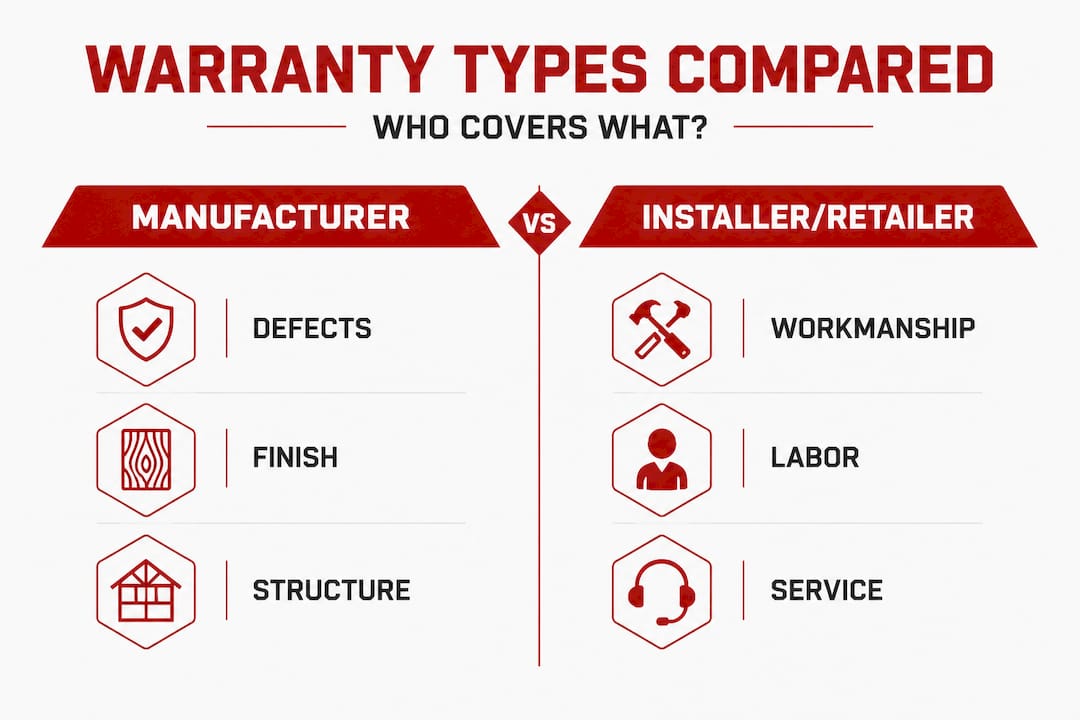
Here’s a quick side-by-side look at how they divide responsibility:
| Issue type | Manufacturer | Retailer | Installer |
|---|---|---|---|
| Board delamination or warping | ✓ Covered | Not covered | Not covered |
| Wrong product delivered | Not covered | ✓ Covered | Not covered |
| Gaps from poor nailing technique | Not covered | Not covered | ✓ Covered |
| Finish peeling early | ✓ Often covered | Not covered | Not covered |
| Uneven boards from bad subfloor prep | Disputed | Not covered | ✓ Covered |
Notice how the table reveals something important: there are real gray zones. Take an uneven floor. If the boards themselves are defective, that’s a manufacturer issue. If the installer skipped proper subfloor installation checks, that’s on the installer. If the product wasn’t stored correctly at the retailer’s warehouse and absorbed moisture, the retailer may share blame. In real disputes, multiple parties point fingers at each other, leaving you in the middle.
Some situations where responsibilities blur:
- Boards that cup or crown shortly after installation (could be moisture from the subfloor, installer error, or a manufacturing flaw)
- Finish that dulls faster than expected (could be a finish defect or improper cleaning products)
- Squeaking floors (could be installation or product related)
Pro Tip: Always ask whether your flooring warranty is transferrable before purchasing. If you sell your home, a transferrable warranty can be a genuine selling point, especially for buyers weighing the long-term value of your floors. Many warranties are void the moment ownership changes hands, and buyers looking at manufacturer vs. installer warranties will want to know who covers what going forward.
What’s really covered (and what’s not)
The headline on a warranty brochure almost never tells the full story. “25-year finish warranty” sounds bulletproof until you read the exclusions section, which is often longer than the coverage section itself.
Here’s a realistic picture of what most standard hardwood flooring warranties include versus what they leave out:
| Typically covered | Typically excluded |
|---|---|
| Manufacturing defects (delamination, warping) | Normal scratches and dents |
| Structural integrity failures | Water and moisture damage |
| Finish peeling due to product defects | Damage from improper cleaning products |
| Milling inconsistencies | Pet scratches and stains |
| Early finish wear under normal conditions | Commercial use of residential products |
| Significant color variation beyond tolerance | Acts of God (flooding, fire) |
Common exclusions include normal wear and tear such as scratches and fading, water and moisture damage, improper installation or maintenance, commercial use of residential products, pet damage, acts of God, and failure to acclimate the flooring before installation. That’s a long list. And every one of those exclusions is a door a manufacturer can close on your claim.
The three most misunderstood exclusions in hardwood flooring warranties:
- “Normal wear and tear” This phrase is deliberately vague. Manufacturers define it broadly, which means almost any surface damage can fall under this label. A finish that dulls after three years might seem like a defect to you, but a manufacturer may classify it as normal wear. This is why installation errors and warranty limits matter so much from day one.
- Failure to acclimate Hardwood needs time to adjust to the humidity and temperature of your space before installation. Most manufacturers require 48 to 72 hours of acclimation. Skip this step, or have your installer skip it, and your entire structural warranty can be voided before a single plank is nailed down.
- Improper maintenance Using the wrong cleaning product even once is enough to void finish coverage under many warranties. Steam mops, oil soaps, and excessive water are frequent culprits. Manufacturers require their specific approved cleaners and methods. Without documentation that you followed those guidelines consistently, a claim can be dismissed quickly.
“Ambiguous ‘normal wear’ definitions usually favor manufacturers in claims. Documenting installation and maintenance rigorously from the start is the single most effective way to protect your position.” This is the kind of practical reality that most warranty brochures quietly avoid mentioning.
Pro Tip: Start a simple folder, physical or digital, the day your floors are installed. Keep installation receipts, the product care guide, photos of the finished floor, and a log of any cleaning products you use. Every time you have the floor professionally cleaned or refinished, add that receipt. This paper trail is your best evidence in any dispute. Following proper installation practices is the foundation, but documentation is what makes that foundation defensible.
Lifetime and finish warranties: Fact vs. fiction
“Lifetime structural warranty” is one of the most powerful phrases in flooring marketing. It implies permanence, quality, and total peace of mind. In practice, it’s far more limited than it sounds, and smart shoppers know to look past the headline.
What a lifetime structural warranty typically does cover:
- Delamination of the core layers in engineered hardwood
- Structural failure not caused by moisture or misuse
- Significant warping due to manufacturing defects
What a lifetime structural warranty typically does not cover:
- Finish wear, scratches, or dullness of any kind
- Any damage related to moisture (even minor humidity fluctuations)
- Labor costs to replace defective boards
- Issues arising from improper installation
- Normal color change from sun exposure over time
That last point about labor is critical. A manufacturer might agree to send you replacement boards, but if they don’t cover labor, you’re paying an installer out of pocket to pull up and reinstall your entire floor. The boards are “free,” but the job can cost thousands of dollars.
This is why finish coverage is actually a more meaningful indicator of warranty quality than structural coverage for most homeowners. Your floors’ surface is what you see and use every single day. A 15-year finish warranty from a brand that actually honors claims beats a “lifetime” structural promise from a brand that makes claims difficult.
Expert analysis confirms that while lifetime structural coverage sounds robust, finish coverage is the real differentiator in everyday value. And the real flooring lifespan of your investment depends heavily on how well the finish holds up over years of foot traffic, furniture, and life in general.
Here’s a stat worth holding onto: according to flooring industry researchers, brands with high claim fulfillment rates and NWFA-compliant (National Wood Flooring Association) processes consistently outperform longer warranty lengths when it comes to actual owner satisfaction. A 30-year warranty from a brand that denies 80% of claims is worth significantly less than a 15-year warranty from a brand with a strong track record.
Getting the most from your warranty: Documentation and best practices
Knowing your rights is one thing. Being able to prove them when it matters is another. Here’s a practical, step-by-step approach to warranty protection that most homeowners skip entirely.
Before installation:
- Photograph all product packaging, including batch and lot numbers. If boards from a defective batch cause problems later, you’ll need this information.
- Confirm your installer is licensed and familiar with the manufacturer’s installation requirements. An installer who skips steps voids your coverage. Review job preparation steps so you know what proper prep looks like.
- Test your subfloor for moisture. Many warranties require documented moisture readings below a specific threshold. If you’re installing over concrete, check concrete slab preparation guidelines carefully.
- Keep the acclimation period log. Note the start and end dates and the temperature and humidity conditions in the room.
During installation:
- Take photos at each major stage: the subfloor, the underlayment, the first rows of boards, and the finished room.
- Have your installer provide written documentation of what they did, including any deviations from standard practice and why.
After installation:
- Register your warranty immediately. Many manufacturers require registration within 30 days, and missing this deadline can void coverage entirely.
- Record every cleaning product you use, every professional service, and any furniture pads or area rugs added to protect the floor.
- Conduct a visual inspection every six months. Note any changes in appearance and photograph anything that looks unusual.
Pro Tip: Set calendar reminders twice a year for floor inspections and once a year to review your maintenance log. Documenting installation and maintenance rigorously is the single most effective strategy for keeping claims viable, because the burden of proof almost always falls on the homeowner, not the manufacturer.
The uncomfortable truth about flooring warranties
Here’s what most warranty guides won’t say plainly: the length printed on a warranty document has almost no correlation with how protected you actually are.
We’ve seen homeowners with 50-year warranty products fight for months to get manufacturers to acknowledge obvious defects. We’ve also seen 10-year warranties honored quickly and fairly because the brand had a culture of accountability. The paperwork matters less than the company standing behind it.
Real warranty value lies in exclusions, labor coverage, and brand claim fulfillment rates, not in how many years are printed on the box. Brands that align with NWFA-compliant processes have a standard to be held to. Brands that don’t can interpret their own vague language however they like.
The other overlooked factor? Your installer. An improperly installed floor gives manufacturers a legal off-ramp on almost every claim. Structural warranty, finish warranty, it doesn’t matter. If the installation deviated from guidelines, the manufacturer can walk away. Choosing a skilled, certified installer is as important as choosing a good product.
And here’s the reality about flooring lifespan realities: well-maintained hardwood floors from reputable brands, installed correctly, regularly outlast their warranty periods without any claims at all. The goal isn’t to maximize your ability to file claims. It’s to buy smart, install right, and maintain consistently so you never need to.
Explore quality flooring and expert guidance
Ready to take the next step armed with real knowledge about flooring warranties?
At Kapriz Hardwood Floors, we’ve built our business around products we would install in our own homes. Every option in our catalog, from high-end luxury brands to budget-friendly choices, comes with the quality and transparency you need to make a confident decision.
Browse our full selection of hardwood flooring options and get guidance on choosing the right product for your space and budget. Not sure which grade suits your needs? Our grade selection guide takes the guesswork out of the decision. And if you’re planning whole-home wood flooring, we can help you think through consistency, budget, and long-term value from room to room. We’re here to make sure your warranty protects you, and that you never need to use it.
Frequently asked questions
What voids a hardwood flooring warranty?
Typical warranty voids include improper installation, lack of acclimation, moisture or water damage, and failure to follow the manufacturer’s maintenance guidelines. Even using a non-approved cleaning product once can be grounds for denial.
Do warranties cover pet scratches or spills?
Most warranties explicitly exclude pet damage, including scratches, stains, and moisture from spills or accidents, treating them as normal wear or as a specific named exclusion. Always check this section of your warranty before purchasing if you have pets.
Can a hardwood flooring warranty be transferred to a new owner?
Some warranties are transferrable, but many are not, or they come with strict conditions such as a limited transfer window or reduced coverage terms. Check the fine print before buying or selling, because a transferrable warranty can genuinely add to a home’s resale value.
Is a longer warranty always better?
Not at all. Real warranty value comes from exclusions, labor coverage, and how reliably a brand honors claims, not the number of years on the label. A shorter warranty from a brand with a strong fulfillment track record is worth more than a lengthy promise from a company that routinely denies claims.
How do I make a successful warranty claim?
Document installation and maintenance rigorously from day one, follow all care instructions precisely, and contact your installer or manufacturer as soon as you notice a problem. Delays in reporting issues often give manufacturers additional grounds for denial.

