

Bay Area Hardwood Floors: Affordable Options & Upgrades
TL;DR:
- Refinishing hardwood floors costs significantly less and extends their lifespan by 10 to 15 years.
- Engineered hardwood is preferred in the Bay Area due to climate factors, offering better moisture resistance.
- Proper preparation, sanding, and finishing are essential to achieve durable, budget-friendly hardwood upgrades.
Upgrading your hardwood floors in the Bay Area sounds exciting until you see the price tags. Full replacement can run $8 to $25 per square foot, while refinishing the same floor costs just $2 to $8 per square foot and adds 10 to 15 years of life. That gap is significant, especially in a region where every dollar counts. The good news is that with the right assessment, smart material choices, and a clear process, Bay Area homeowners can get beautiful, durable floors without draining their savings. This guide walks you through every step.
Table of Contents
- Assessing your current floors: When refinishing makes sense
- Budget-friendly materials: Choosing engineered or solid hardwood
- Step-by-step refinishing: How to upgrade on a budget
- Results and longevity: What to expect from budget upgrades
- Our take: What Bay Area homeowners overlook in budget flooring upgrades
- Affordable hardwood solutions from Kapriz Hardwood Flooring Store
- Frequently asked questions
Key Takeaways
| Point | Details |
|---|---|
| Refinishing is budget-friendly | Most Bay Area hardwood floors can be upgraded affordably by refinishing, saving thousands over replacement. |
| Engineered hardwood suits local climate | Engineered hardwood offers better moisture resistance and value for Bay Area homeowners. |
| Proper prep extends floor life | Careful inspection and acclimation help maintain floor durability and avoid costly mistakes. |
| Quality trumps lowest price | Choosing durable species and trusted installation ensures lasting returns from flooring upgrades. |
Assessing your current floors: When refinishing makes sense
Before spending a single dollar, you need to know what you’re working with. Walk every room and look closely at your existing hardwood. Are the boards cupping, splitting, or showing deep gouges? Is the finish worn through to bare wood in high-traffic areas? These are signs that refinishing could restore your floors completely, without the cost of tearing everything out.
The most important factor is board thickness. Boards under 3/4 inch thick or those with structural damage like rot, severe warping, or subfloor issues require full replacement rather than refinishing. Sanding a thin board removes too much material and leaves you with a floor that can’t be refinished again later.
For floors in decent structural shape, refinishing adds 10 to 15 years at a fraction of replacement cost. Here’s a quick comparison to put the numbers in perspective:
| Option | Cost per sq ft | Lifespan added | Best for |
|---|---|---|---|
| Refinishing | $2 to $8 | 10 to 15 years | Structurally sound floors |
| New engineered hardwood | $8 to $15 | 25 to 50 years | Damaged or thin boards |
| New solid hardwood | $12 to $25 | 80 to 100 years | Long-term investment |
When inspecting your floors, check for these red flags that point toward replacement:
- Boards thinner than 3/4 inch (already sanded multiple times)
- Soft spots or bounce when you walk, indicating subfloor damage
- Persistent moisture staining or black discoloration from mold
- Boards that are loose, squeaky, or shifting at the seams
- More than 30% of boards showing surface cracks or splits
If none of these apply, you’re likely a great candidate for cheap hardwood upgrades through refinishing. Check your hardwood floor lifespan expectations against your floor’s age to make a confident call.
Pro Tip: Tap a coin across your boards. A hollow sound means the board has separated from the subfloor and may need to be re-nailed or replaced before sanding begins.
The Bay Area flooring costs for refinishing are genuinely one of the best values in home improvement. Most homeowners who refinish instead of replace save between $6,000 and $20,000 on a typical 1,000 square foot floor.
Budget-friendly materials: Choosing engineered or solid hardwood
Once you’ve determined that replacement is necessary, or you want to expand your floor into new rooms, choosing the right material is where smart budgeting really pays off. In the Bay Area, this decision is shaped by both cost and climate.
The Bay Area’s microclimates are notorious. Coastal fog in Daly City, dry heat in Walnut Creek, and humidity swings in Oakland all affect how wood behaves. Solid hardwood expands and contracts with humidity changes, which can cause gapping or cupping if not managed carefully. Engineered hardwood for Bay Area homes handles these swings much better because its layered construction resists moisture movement.
Engineered hardwood is preferred in the Bay Area for both budget and climate reasons, lasting 25 to 50 years or more, while solid hardwood lasts longer and allows more refinishing cycles over its life.
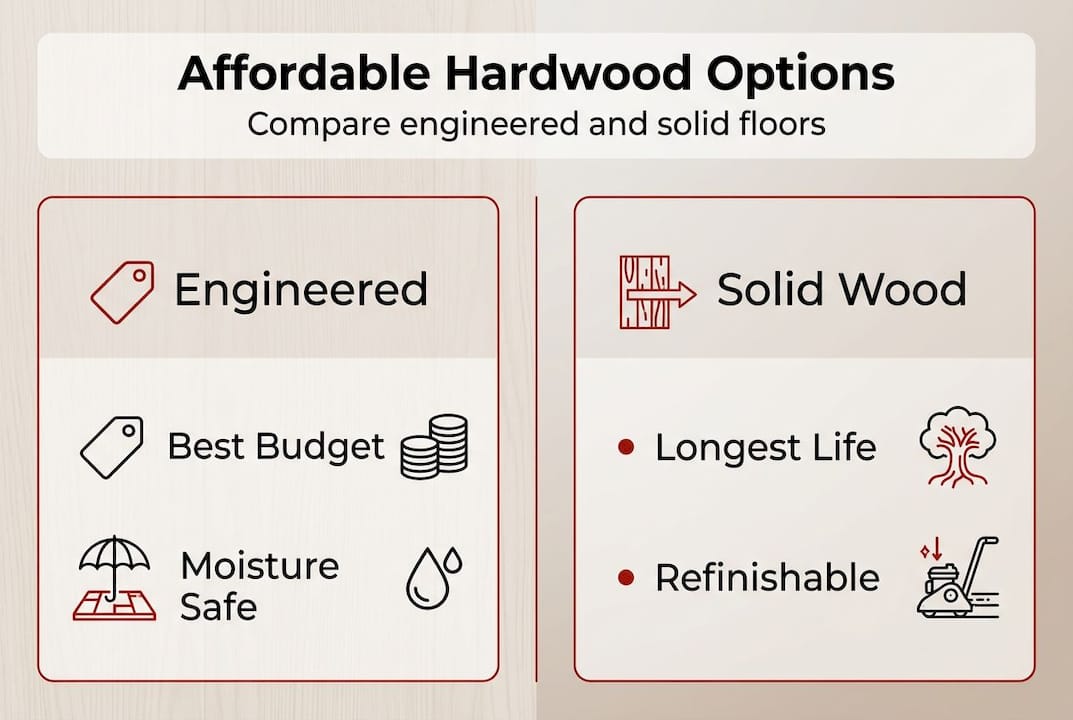
Here’s how the two stack up for Bay Area buyers:
| Feature | Engineered hardwood | Solid hardwood |
|—|—|—|—|
| Cost per sq ft (material) | $3 to $10 | $6 to $18 |
| Humidity resistance | High | Moderate |
| Refinishing cycles | 1 to 3 | 4 to 7 |
| Lifespan | 25 to 50 years | 80 to 100 years |
| Best use | Most Bay Area rooms | Stable, dry interiors |
For budget buyers, the best species to consider include:
- White oak: Excellent durability, Janka hardness of 1,360, and a neutral grain that fits modern and traditional homes alike. It’s the top value pick.
- Hickory: Very hard at 1,820 Janka, hides wear well, and costs less than exotic species.
- Maple: Smooth grain, affordable, and extremely hard at 1,450 Janka.
- Ash: Similar look to white oak at a slightly lower price point in some markets.
Explore the full range of durable hardwood options and compare wood floor types before committing to a purchase. The cheapest board per square foot is rarely the best value when you factor in lifespan and refinishing potential.
Hardwood durability data consistently shows that mid-grade engineered white oak offers the best combination of upfront cost, longevity, and climate compatibility for Bay Area homeowners on a budget.
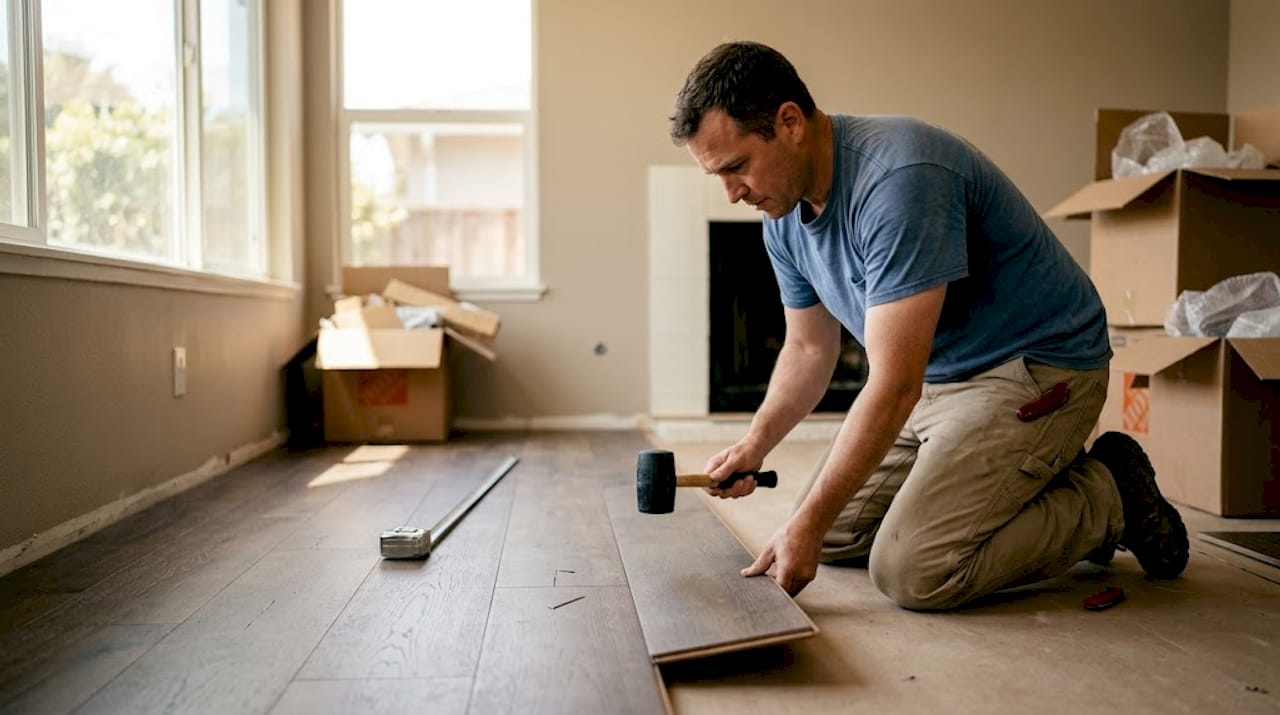
Step-by-step refinishing: How to upgrade on a budget
Refinishing is where the biggest savings happen. Done right, it transforms a dull, scratched floor into something that looks brand new. Here’s the process broken down clearly.
- Inspect and prep the room. Remove all furniture, check for protruding nails, and re-nail any loose boards. Seal vents and doorways with plastic sheeting to contain dust.
- Choose your sanding system. Dustless drum sanders are strongly recommended for Bay Area homes. They reduce cleanup time and keep fine particles out of your HVAC system.
- Sand in stages. Start with coarse grit (36 to 40) to remove the old finish, then move to medium (60 to 80) to smooth the surface, and finish with fine grit (100 to 120) for a clean, even base.
- Clean thoroughly. Vacuum and tack-cloth the entire surface before any finish goes down. Even a small amount of dust under the finish will ruin the final look.
- Apply stain (optional). If you want a color change, now is the time. Apply evenly with the grain and allow full drying before the next step.
- Apply 2 to 3 coats of polyurethane. Water-based polyurethane dries faster and has lower odor, which matters in Bay Area homes with limited ventilation. Oil-based offers a warmer tone but takes longer.
- Allow full cure time. Light foot traffic is fine after 24 hours, but avoid rugs and furniture for at least 72 hours. Full cure takes 7 to 14 days.
The full refinishing process from inspection through finishing coats typically takes 2 to 5 days depending on room size and drying conditions. Dustless systems are strongly recommended to keep the job clean and efficient.
“The biggest mistake homeowners make is rushing the finish coats. Each coat needs to be fully dry before the next one goes down. Cutting that time short leads to peeling within months.”
Pro Tip: Rent a dustless orbital sander for edges and corners. Standard edge sanders are aggressive and easy to over-sand, leaving visible swirl marks that show through the finish.
Follow the complete floor refinishing steps and review affordable refinishing tips before you start to avoid the most common and costly mistakes.
Results and longevity: What to expect from budget upgrades
Once the work is done, you want to know what you’re getting for your money. The results from a well-executed refinishing or smart material upgrade are genuinely impressive, both visually and financially.
For a 1,200 square foot floor, refinishing costs between $4,800 and $9,600, compared to $14,400 to $30,000 for full replacement. That’s a potential savings of nearly $20,000 on a single project, and the flooring cost comparisons back this up consistently.
Here’s what you can realistically expect after a quality budget upgrade:
- Refinished floors: 10 to 15 additional years of life with proper maintenance
- New engineered hardwood: 25 to 50 years with 1 to 3 refinishing cycles
- New solid hardwood: 80 to 100 years with 4 to 7 refinishing cycles
- Home value boost: Hardwood floors consistently rank among the top ROI improvements for resale
- Maintenance needs: Sweep weekly, damp mop monthly, and recoat every 3 to 5 years for best results
For a 1,200 sq ft refinish at $4,800 to $9,600 versus replacement at $14,400 to $30,000, the math strongly favors refinishing for floors in good structural condition.
Maintenance is where many homeowners lose the gains they made on the upgrade. Use only pH-neutral hardwood cleaners. Avoid steam mops, which force moisture into the wood grain. Place felt pads under all furniture legs and use entry mats to trap grit before it scratches the finish.
Review the full hardwood upgrade pros and cons and explore ideal hardwood solutions for your specific home type to make the most of your investment.
Our take: What Bay Area homeowners overlook in budget flooring upgrades
Here’s something most flooring guides won’t tell you: the cheapest option upfront is almost never the cheapest option over time. We’ve seen homeowners skip acclimation to save a day, only to watch their new floors cup and gap within weeks. We’ve seen ultra-cheap engineered boards delaminate after two years in a coastal microclimate. These aren’t rare exceptions. They’re predictable outcomes of cutting the wrong corners.
Acclimation for 7 to 14 days is critical in Bay Area microclimates to prevent cupping and gapping. White oak is consistently the best durable budget species for this region. It’s not the absolute cheapest board on the shelf, but it holds up, refinishes well, and looks great for decades.
The real value in budget flooring isn’t finding the lowest price. It’s finding the best price for something that lasts. When you’re choosing hardwood floors for a Bay Area home, factor in your microclimate, your subfloor condition, and your long-term plans for the property. Those three things will tell you more than any price tag.
Affordable hardwood solutions from Kapriz Hardwood Flooring Store
Ready to take the next step? At Kapriz Hardwood Floors, we stock a full range of budget-friendly and premium hardwood options, and we only carry products we’d put in our own homes.
Whether you’re shopping for engineered white oak, solid hardwood, or need help deciding between the two, our team is here to guide you without the pressure. Browse our full hardwood floor shopping selection, get practical advice on choosing affordable floors that balance quality and cost, or explore our complete guide to shop hardwood quality options for every budget. Great floors don’t have to cost a fortune. Let us help you find the right fit.
Frequently asked questions
How much does refinishing hardwood floors cost in the Bay Area?
Refinishing costs $2 to $8 per square foot, adding 10 to 15 years of life at a fraction of full replacement cost. It’s the most budget-friendly upgrade available for structurally sound floors.
What hardwood species are best for budget and durability?
White oak at Janka 1,360 is the top budget-friendly species for Bay Area homes, offering excellent durability, moisture resistance, and a timeless look that fits most interior styles.
How long does a refinished floor last compared to a new installation?
A refinished floor adds 10 to 15 years of life, while solid hardwood lasts 80 to 100 years and engineered hardwood lasts 25 to 50 years with proper care and maintenance.
Why is acclimation important with hardwood flooring upgrades?
Acclimation for 7 to 14 days allows wood to adjust to your home’s humidity and temperature, preventing cupping, gapping, and buckling that are especially common in Bay Area microclimates.


